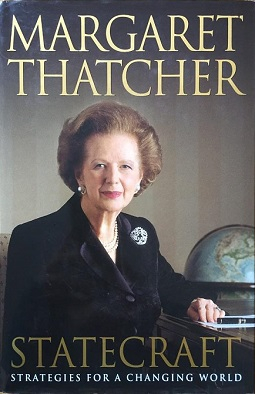
Statecraft: Strategies for a Changing World published
United Kingdom
Political
Economy
Sustainability
8 min read
Updated By: History Editorial Network (HEN)
Published:
Margaret Thatcher's book *Statecraft: Strategies for a Changing World* was published in 2002, over a decade after she had stepped down as Prime Minister of the United Kingdom. This book reflects on the global political landscape at the turn of the 21st century, offering Thatcher's insights and strategic thoughts on international relations, economics, and governance. As the "Iron Lady" who shaped Britain's domestic and foreign policies during the 1980s, Thatcher’s reflections in *Statecraft* provided a continuation of her influential voice on world affairs, despite her retirement from active politics.
In *Statecraft*, Thatcher presents a robust defense of her political philosophies, particularly her belief in national sovereignty, free-market economics, and strong leadership. She revisits some of the key moments of her career, offering reflections on the Cold War, the European Union, and her interactions with global leaders such as Ronald Reagan, Mikhail Gorbachev, and Deng Xiaoping. The book also delves into issues that arose after her time in office, such as globalization, terrorism, and the evolving role of NATO.
One of the book's key themes is Thatcher’s skepticism toward the European Union. She critiques what she perceives as the EU’s drive toward greater political integration, warning that it threatens national sovereignty and democratic accountability. Thatcher’s views on Europe had evolved over the years, and in *Statecraft*, she solidifies her opposition to further EU integration, arguing that Britain’s future lay in maintaining its independence rather than becoming more deeply entwined with Brussels. This stance would foreshadow the sentiments that eventually culminated in the Brexit referendum more than a decade later.
Thatcher also addresses the United States' role as the world’s superpower, offering praise for American leadership while stressing the importance of maintaining alliances rooted in shared values and interests. She remains firmly committed to the special relationship between the UK and the US, which she believed was vital for global stability and the spread of democratic values. She discusses the importance of standing firm against rogue states and emerging threats like international terrorism, writing in the context of a post-9/11 world. Her advocacy for strong national defense and a clear foreign policy reflects the same principles that guided her during the Falklands War and her support of NATO during the Cold War.
In addition to foreign policy, *Statecraft* touches on domestic governance, where Thatcher reiterates her belief in free-market principles and limited government intervention. She argues that these policies, which came to define her tenure as Prime Minister, are essential for promoting individual freedom and national prosperity. Thatcher critiques what she perceives as the increasing encroachment of government into private lives, advocating for a continued emphasis on individual responsibility and entrepreneurship.
*Statecraft* is not just a retrospective on Thatcher’s own policies, but a prescriptive guide for future world leaders. She offers a framework for navigating the rapidly changing political landscape of the early 21st century, advocating for a return to the values that she believed had brought peace and prosperity to the West: strong national sovereignty, free markets, and steadfast leadership.
Although *Statecraft* received a mixed reception—praised by those who shared her views and criticized by those who opposed her legacy—it remains an important work for understanding Thatcher’s enduring political philosophy and her vision for the future. Her unwavering commitment to her principles shines through the book, offering a glimpse into how she believed nations should confront the challenges of a new world order.
#MargaretThatcher #Statecraft #InternationalRelations #PoliticalPhilosophy #IronLady #Leadership #EuropeanUnion #USUKRelations #MoofLife #MomentsOfLife
Primary Reference
Statecraft: Strategies for a Changing World: Thatcher, Margaret ...
Explore the Life Moments of
 AI Twin