Malta Labour Party Secures Historic Fourth Consecutive Election Victory in 2026
Valletta, Naxxar and nationwide polling locations, Malta
Political
7 min read
Updated By: History Editorial Network (HEN)
Published:
Updated:
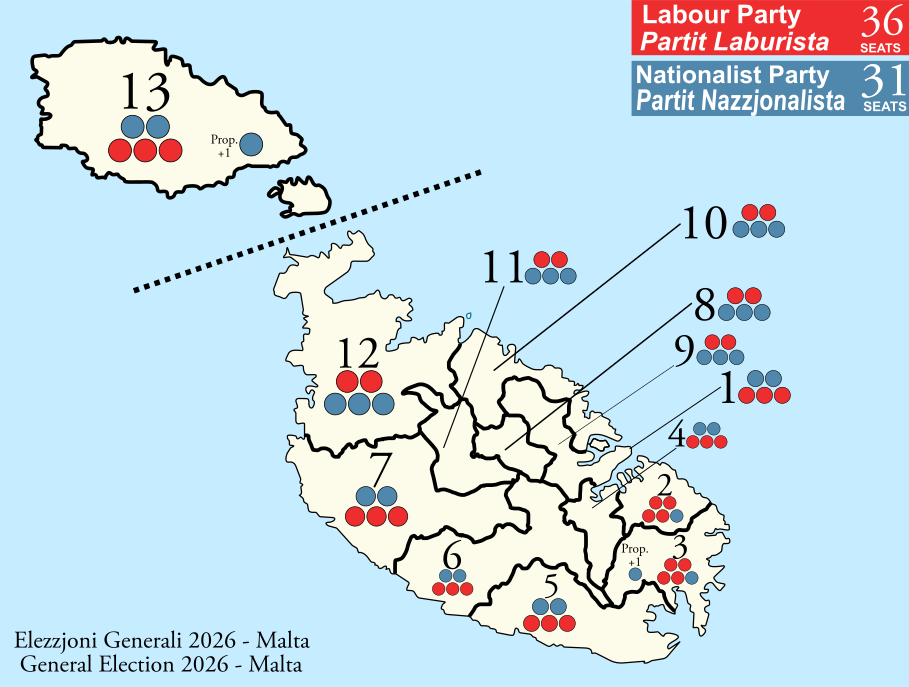
On 30/05/2026, Malta's ruling Labour Party (Partit Laburista) won a historic fourth consecutive general election, extending its time in government and giving Prime Minister Robert Abela a renewed mandate to lead the country. The snap election had been called a year ahead of schedule after Abela argued that Malta needed political stability amid international uncertainty and economic challenges.
The election delivered a record result in Malta's modern political history, as no political party had previously secured four successive general election victories. The Labour Party has governed Malta continuously since 2013 and maintained its position as the country's dominant political force. Preliminary and final counts showed Labour winning a clear parliamentary majority, with approximately 51.77% of the national vote and a lead of more than 21,000 votes over the opposition Nationalist Party (PN).
Prime Minister Robert Abela, who became Labour leader and Prime Minister in 2020, secured his second election victory as party leader following the 2022 election. After the result became clear, Labour supporters gathered at party headquarters and participated in traditional celebrations across Malta. Abela described the outcome as a strong mandate based on the programme presented to voters and called for national unity as his government prepared to implement its electoral agenda.
Voter participation remained exceptionally high by European standards. Official turnout reached 87.4%, slightly higher than the turnout recorded during the 2022 election. The election featured six political parties, but Labour and the Nationalist Party once again remained the only parties expected to secure parliamentary representation, continuing a political pattern that has existed in Malta since 1966.
The opposition Nationalist Party was led by Alex Borg, who had assumed leadership only months before the election. Although the party acknowledged defeat, Borg highlighted that the Nationalists had reduced Labour's previous electoral advantage. Labour's lead was considerably smaller than the margin recorded in the 2022 election, reflecting gains made by the opposition despite the overall result.
Economic issues played a central role throughout the campaign. Abela repeatedly pointed to Malta's economic performance, including strong growth, low unemployment and controlled energy prices, as evidence of government competence and stability. The Nationalist Party, meanwhile, argued that economic growth had not fully translated into improved quality of life for all residents and raised concerns about housing costs, infrastructure pressures and migration-related challenges.
Why This Moment Matters:
The 2026 election established a new electoral record in Malta by delivering a fourth consecutive mandate to a single party. The result also confirmed Robert Abela's position as the country's political leader at a time when economic management, regional instability and long term development issues remain central topics in Maltese public life.
Members of the Malta Labour Party (PL) react at the Electoral Commission Counting Complex in Naxxar, on the island of Malta on May 31, 2026. Malta's Labour party has won an unprecedented fourth term in a victory for outgoing Prime Minister Robert Abela, a sample count of ballots showed on May 31. Preliminary results gave the election to Labour, officials in the Counting House in Naxxar said, as fireworks were set off across the tiny Mediterranean island. (Getty Images)
#RobertAbela
#LabourParty
#PartitLaburista
#MaltaElection2026
#AlexBorg
#NationalistParty
#Valletta
#EuropeanPolitics

Explore the Life Moments of
 AI Twin