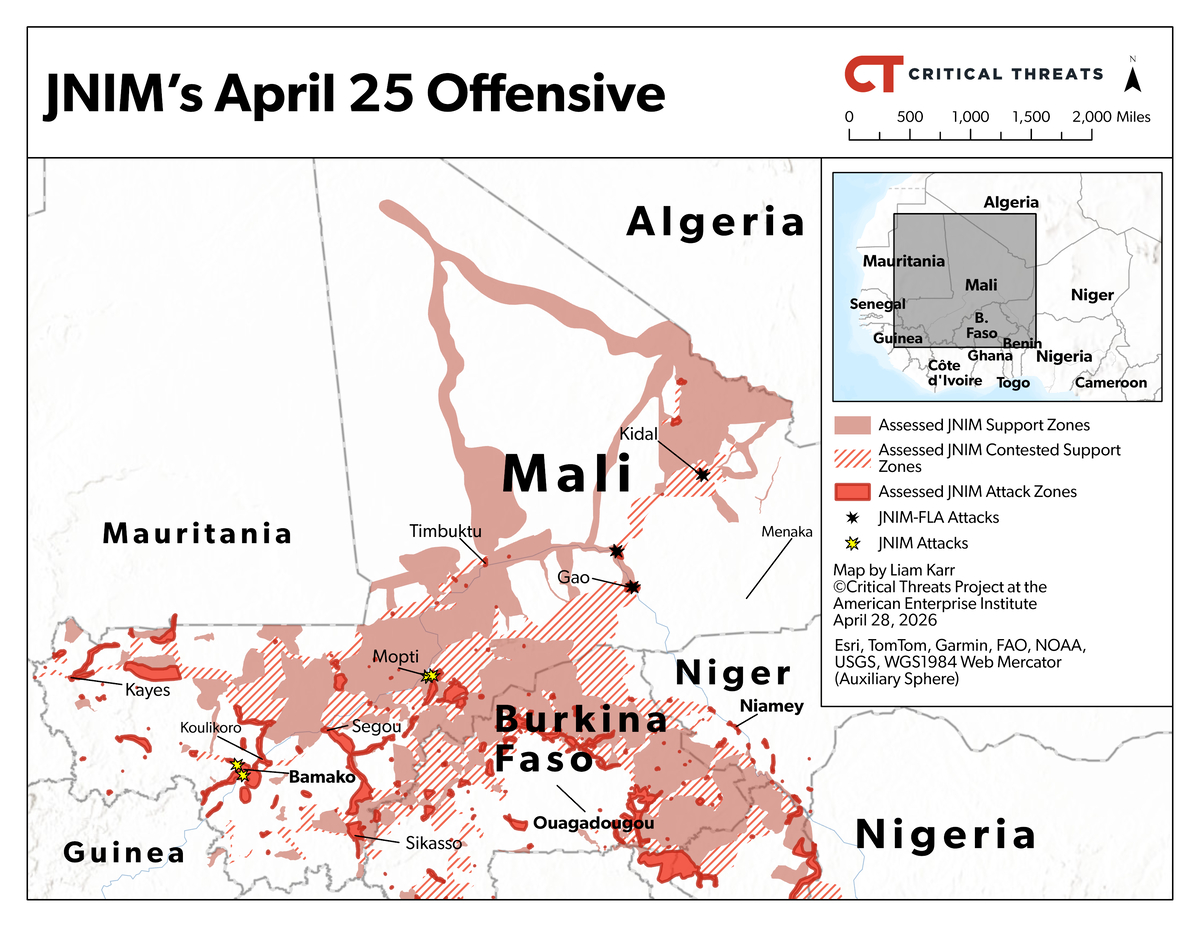
Coordinated Offensive in Mali by JNIM and the Azawad Liberation Front
Mali
Political
7 min read
Updated By: History Editorial Network (HEN)
Published:
On 25/04/2026, Mali experienced a large scale coordinated offensive that brought simultaneous attacks to multiple regions of the country and marked the most extensive insurgent operation since the 2012 conflict. The offensive was carried out by Jama'at Nusrat al-Islam wal-Muslimin (JNIM), an Al Qaeda affiliated militant group, in alliance with the Azawad Liberation Front (FLA), a coalition of Tuareg and Arab separatist factions. The attacks began at dawn and targeted military positions, airports, government facilities, and strategic urban centers across Mali, including areas near Bamako, Kati, Gao, Kidal, Mopti, and Sevare. Militants employed a combination of ground assaults, vehicle-borne explosive attacks, drones, and coordinated raids to stretch government forces across multiple fronts.
According to multiple reports, the operation represented an unprecedented level of cooperation between Islamist insurgents and separatist movements that had historically pursued different objectives. JNIM and FLA forces were reported to have seized or partially controlled several locations in northern Mali while also striking areas close to the national capital. The offensive challenged the authority of Mali's military government and exposed vulnerabilities in the country's security architecture despite years of military operations and support from Russian-backed forces. Analysts described the campaign as the largest coordinated insurgent offensive in Mali since the events of 2012, when jihadist and rebel groups overran much of the country's north.
Among the most sensitive targets was Kati, a military hub located near Bamako and historically associated with several coups in Mali. Reports indicated that attacks there began around 05:00 local time and included explosions, gunfire, and strikes against military facilities. Simultaneous operations were also reported around Modibo Keïta International Airport and military installations in central and northern regions. The broad geographic scope of the offensive suggested extensive planning and coordination aimed at overwhelming government responses and disrupting military command structures.
The attacks triggered a significant political and security crisis for Mali's ruling junta. Rebel and jihadist advances weakened state control in several areas and intensified concerns about the government's ability to secure the country. The offensive also highlighted the re-emergence of alliances between separatist and jihadist actors, a dynamic that had played a central role during the 2012 conflict but had become less visible in subsequent years. In the weeks that followed, fighting continued across several regions, with both the Malian government and insurgent groups claiming gains.
Historical Significance:
The coordinated offensive of 25/04/2026 stands out because it combined nationwide military pressure with an open alliance between JNIM and the FLA. The operation revived comparisons with the 2012 insurgent advance and demonstrated the capacity of armed groups to conduct synchronized attacks across vast distances in Mali. The event also underscored the continuing instability of the Sahel and the evolving relationships between separatist and jihadist movements in the region.
#Mali #Sahel #SecurityCrisis #WestAfrica #ConflictHistory
#JNIM
#AzawadLiberationFront

Explore the Life Moments of
 AI Twin