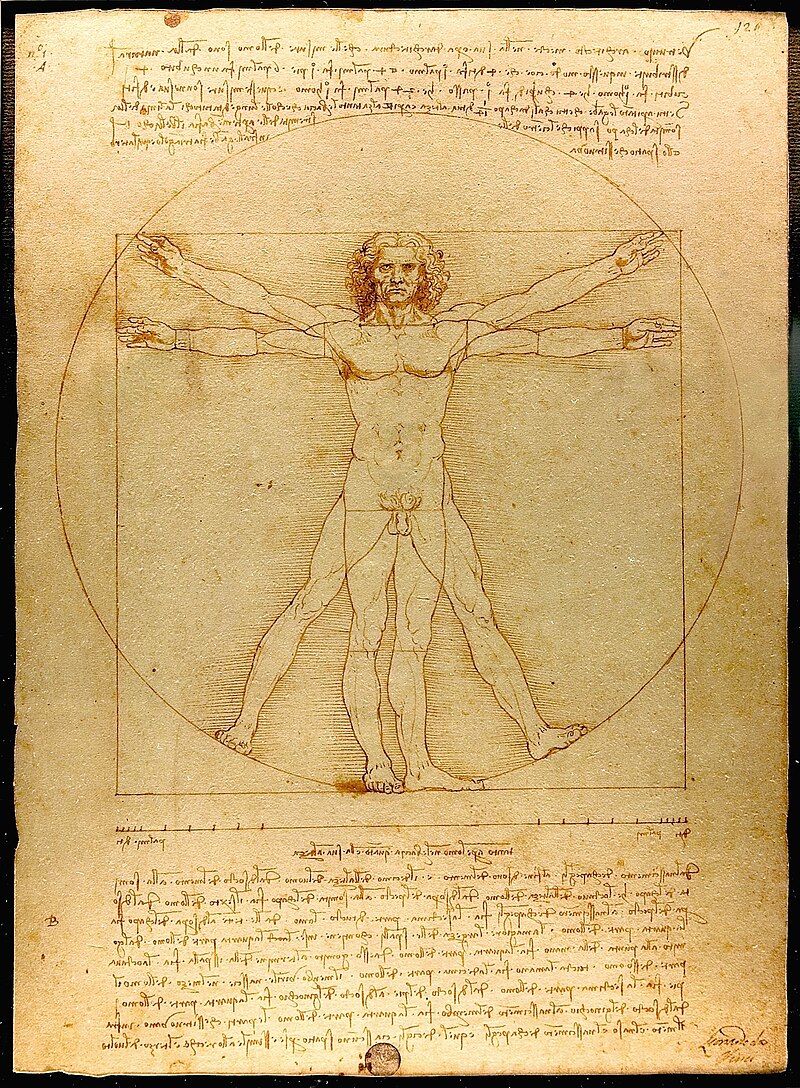
Leonardo da Vinci's Vitruvian Man: Fusion of art and science in human proportions.
Italy
Art
Science
3 min read
Updated By: History Editorial Network (HEN)
Published:
Updated:
Leonardo da Vinci created the Vitruvian Man as a study of human proportions inspired by Vitruvius’s principles. The drawing was part of Leonardo's notebook, reflecting his admiration for the ancient Roman architect, Vitruvius. Vitruvius had outlined the proportions of the human body in his work "De Architectura," stating that a well-proportioned body could fit perfectly within a circle and a square.
Leonardo’s sketch illustrated this concept with a man standing in two superimposed positions with his arms and legs apart inside both shapes. This work wasn’t just an artistic endeavor; it merged art and science, showcasing Leonardo’s dedication to understanding human anatomy and the geometric principles underlying physical symmetry.
This drawing had a lasting impact on both the art and scientific communities, symbolizing the blend of scientific and artistic inquiry during the Renaissance. The Vitruvian Man is regarded as a model of the ideal human form and an exemplar of the fusion of mathematics and art. It remains one of Leonardo da Vinci’s most famous illustrations and continues to be a reference point in studies of human anatomy and art history.
#DaVinci #VitruvianMan #RenaissanceScience #HumanProportions #Vitruvius #IntersectionOfArtAndScience #MoofLife
Explore the Life Moments of
 AI Twin