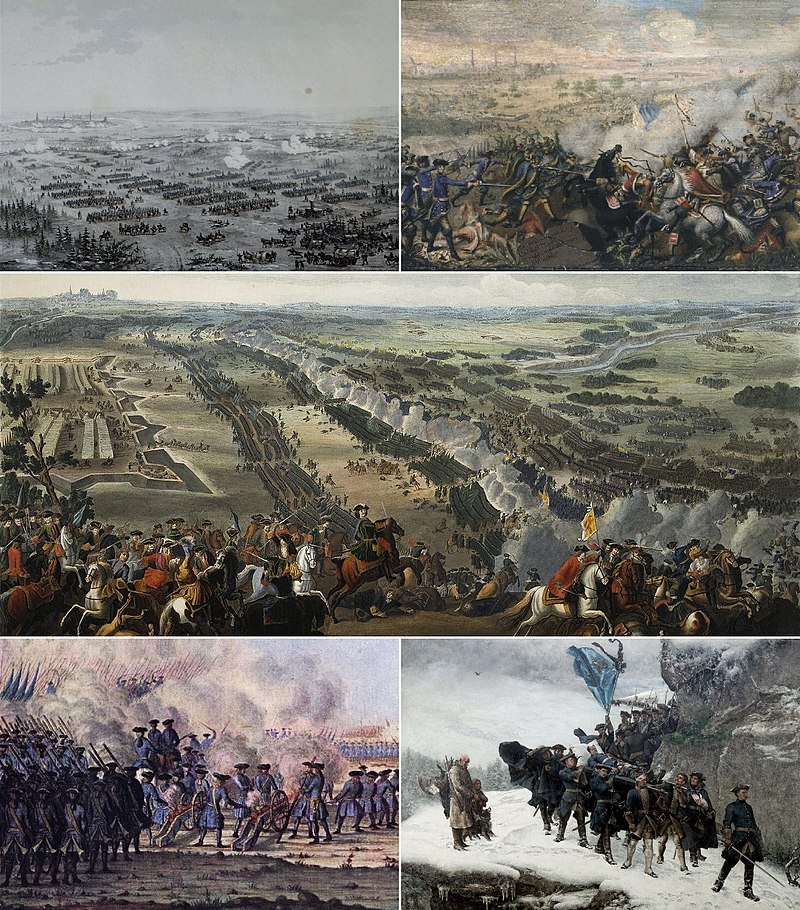
The Great Northern War: Shifting Power in Northern Europe
Latvia
Political
Global Trade
5 min read
Updated By: History Editorial Network (HEN)
Published:
The Great Northern War began as a significant conflict involving the Polish–Lithuanian Commonwealth, Sweden, and Russia. This war marked a crucial shift in the power dynamics of Northern and Eastern Europe. Before the conflict, Sweden was a dominant power in the region, controlling extensive territories along the Baltic Sea. However, neighboring countries including Russia, the Polish–Lithuanian Commonwealth, and Denmark-Norway, sought to challenge Sweden's supremacy. They formed a coalition to curb Sweden's influence and reclaim territories lost in earlier conflicts.
One of the principal reasons for the war was the ambition of Tsar Peter I of Russia to secure more direct access to the Baltic Sea. This access was crucial for Russia to expand its trade routes and enhance its military presence in the Baltic region. Meanwhile, the Polish–Lithuanian Commonwealth was politically divided and weakened by internal nobility conflicts. Its involvement was driven by the desire to regain lands and prestige lost to Sweden.
In the early phase of the war, Sweden, led by the young and tactical King Charles XII, initially had significant successes. However, the war stretched on for over two decades, with major battles fought across Latvia, Lithuania, Poland, and other regions. The conflict significantly drained the resources of the involved nations.
By the end of the war, the balance of power in Northern Europe had drastically altered. Sweden's dominant position was diminished, and it lost substantial territories. Russia emerged as a new great power in the region, achieving the objective of stronger influence in the Baltic Sea and laying the groundwork for St. Petersburg’s establishment. The Polish–Lithuanian Commonwealth, although a participant, was largely weakened further, setting the stage for later partitions.
The war's extensive conflicts and territorial changes significantly affected local populations, leading to economic hardships and demographic shifts. The geopolitical map of Northern and Eastern Europe was redrawn, influencing historical trajectories for centuries.
#GreatNorthernWar #BalticHistory #EuropeanConflicts #MoofLife
Primary Reference
Great Northern War - Wikipedia
Explore the Life Moments of
 AI Twin