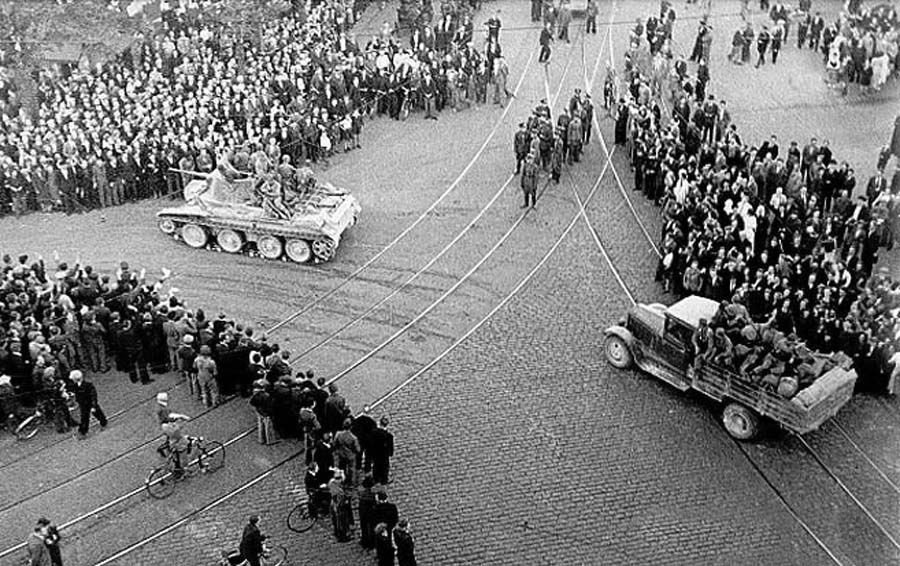
Soviet occupation of Latvia during World War II.
Latvia
Political
Global Trade
5 min read
Updated By: History Editorial Network (HEN)
Published:
In the midst of geopolitical tensions in Europe during World War II, the Soviet Union executed a strategic maneuver that led to the occupation of Latvia. This followed a series of political actions and military preparations indicative of Soviet expansionist aims in the Baltic region. Prior to the occupation, Latvia was an independent republic that had achieved sovereignty after World War I. However, this independence was precariously situated between larger powers amid escalating global conflict.
Under the framework of the Molotov-Ribbentrop Pact, a non-aggression treaty between Nazi Germany and the Soviet Union, both powers demarcated spheres of influence in Eastern Europe. Latvia, along with the other Baltic states, fell into the Soviet sphere. Initial Soviet pressure led to the signing of a mutual assistance treaty between Latvia and the Soviet Union, ostensibly granting the Soviets military bases in Latvian territory. This agreement, however, set the stage for further intervention.
The occupation commenced with the arrival of substantial Soviet military forces and was accompanied by demands for a reshuffling of the Latvian government to include pro-Soviet elements. The Latvian leadership, faced with overwhelming force and fearing total subjugation, acceded to Soviet demands. This occupation proceeded largely without armed resistance.
Subsequently, the Soviet Union orchestrated a series of political changes aimed at annexing Latvia formally. Elections were held under Soviet supervision, resulting in a puppet government that sought incorporation into the USSR. This incorporation was formalized shortly thereafter.
The occupation had profound impacts on Latvia. It led to the suppression of political freedoms, the nationalization of private property, and the imposition of Soviet economic and social systems. There were significant deportations and repressions of dissidents and perceived enemies of the state, with thousands of Latvians sent to Gulags in Siberia.
The Soviet occupation of Latvia remained a sore point in Latvian history, influencing national consciousness and identity for decades. It was not until the dissolution of the Soviet Union that Latvia reasserted its independence, marking the end of a turbulent chapter in its history.
#Latvia #History #SovietOccupation #WWII #Baltics #Geopolitics #MoofLife
Primary Reference
History of Latvia: A brief synopsis
Explore the Life Moments of
 AI Twin