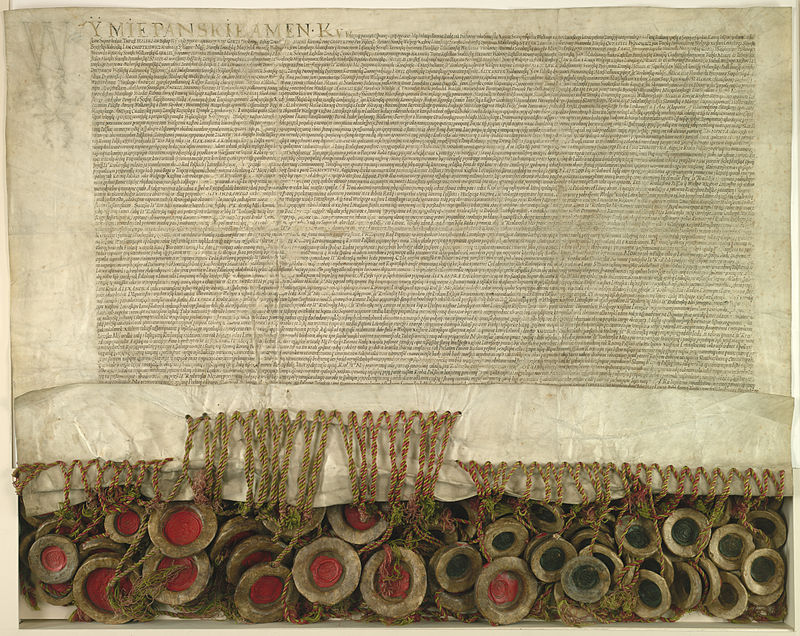
Formation of Polish-Lithuanian Commonwealth through Union of Lublin strengthened unity and defense against external threats.
Latvia
Political
Global Trade
5 min read
Updated By: History Editorial Network (HEN)
Published:
The formation of the Polish–Lithuanian Commonwealth resulted from the Union of Lublin, where Lithuania and Poland combined their territories to create one of the largest and most populous states in Europe. This union came about after years of political and military collaboration, with the aim of strengthening both realms in the face of external threats, particularly from Russia and the Ottoman Empire. By forming a single political entity, Poland and Lithuania hoped to consolidate their resources and enhance their ability to defend their territories.
One significant consequence of this union was the administration of Livonia, a region strategically located on the Baltic Sea, which became a joint domain managed directly by both the Polish and Lithuanian authorities. Livonia's status as a joint domain highlighted the collaborative nature of the new Commonwealth, as both nations shared responsibility for its governance and defense. At the time, Livonia was a region of interest due to its economic potential and strategic position, serving as a gateway for trade and military operations.
The establishment of the Polish–Lithuanian Commonwealth brought about several notable changes. It created a more integrated and centralized political system, while still allowing for local autonomy under a shared monarchy and common institutions. The Commonwealth operated under the principle of *liberum veto*, allowing any member of its parliament to veto decisions, a unique aspect of its political system.
By merging into a single political entity, Poland and Lithuania were able to pool their military and economic resources, which contributed to the security and prosperity of the region in the short term. Livonia's change in administration also marked a shift in regional power dynamics, as it brought the area under the direct influence of the Commonwealth, impacting local governance, trade, and diplomacy.
In summary, the union of Poland and Lithuania to form the Polish–Lithuanian Commonwealth represented a strategic political consolidation, significantly impacting the governance of Livonia and altering the regional power structure of the time.
#PolishLithuanianCommonwealth #UnionOfLublin #Livonia #MoofLife #LatvianHistory
Primary Reference
Livonia - Wikipedia
Explore the Life Moments of
 AI Twin