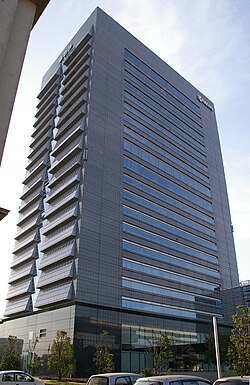
New Kyocera Headquarters Opens
Japan
9 min read
Updated By: History Editorial Network (HEN)
Published:
Updated:
In August 1998, Kyocera Corporation opened its new corporate headquarters in Fushimi-ku, Kyoto, Japan, consolidating its central corporate operations in a purpose-built office complex incorporating environmental technologies, including solar power generation. The headquarters building reflected Kyocera's established involvement in photovoltaic technology and provided a new administrative base for the company's expanding international manufacturing, electronics, and telecommunications businesses.
Kyocera was founded on 01/04/1959 in Kyoto by Kazuo Inamori and seven founding partners. Originally named Kyoto Ceramic Co., Ltd., the company began with ¥3 million in capital and 28 employees, manufacturing fine ceramic insulating components for television equipment. During the following four decades, it expanded into electronic components, semiconductor-related materials, telecommunications equipment, industrial products, and solar energy technology.
The new headquarters was constructed in the Takeda Tobadono-cho area of Fushimi Ward, south of central Kyoto. Its development provided Kyocera with facilities suited to coordinating a larger and more diversified organization. By the late 1990s, the company operated manufacturing, sales, and technical businesses across Japan, North America, Europe, and other international markets.
A distinctive feature of the headquarters was the integration of photovoltaic solar panels into the building. Kyocera had begun researching solar cell technology in 1975 through its involvement in Japan Solar Energy Corporation. During the following decades, the company developed and commercialized multicrystalline silicon solar cells and photovoltaic modules for electricity-generation applications.
The headquarters incorporated solar power technology as part of its building infrastructure, demonstrating a practical application of Kyocera's photovoltaic products in a commercial office environment. Solar panels generate electricity by converting sunlight into electrical energy through semiconductor materials. Integrating these systems into buildings allows a portion of electricity demand to be supplied through on-site generation.
Kyocera's headquarters also incorporated other environmental design considerations intended to improve resource and energy management. The building became associated with the company's approach to environmental technology, combining corporate administrative functions with examples of products developed through its energy-related research and manufacturing activities.
The headquarters relocation occurred during a period of continued corporate expansion. In the 1990s, Kyocera had acquired AVX Corporation, developed cellular telephone manufacturing, and established Kyocera Communication Systems Co., Ltd. in September 1995. These developments increased the range of businesses managed within the Kyocera Group and contributed to the need for facilities supporting its corporate operations.
The new headquarters also became the location of Kyocera's corporate offices and facilities associated with the company's history and technology. The building remains identified with Kyocera's presence in Kyoto, the city where its manufacturing business began in 1959.
Kyocera's official records provide additional details about the building's environmental features. The headquarters was equipped with 1,896 solar panels, installed on its roof and south-facing exterior walls, with a combined generating capacity of 214 kilowatts. The building also incorporated a natural gas cogeneration system, which generated electricity while recovering waste heat for other building functions. Additional technologies included thermal storage air conditioning and energy-efficient ventilation systems.
The headquarters also included approximately 3,300 square meters of publicly accessible outdoor space, landscaped with trees and seasonal plants. Kyocera later established the Kyocera Gallery and the Kyocera Museum of Fine Ceramics inside the headquarters, providing exhibitions connected to art, ceramic technology, and the company's activities.
#Kyocera
#KyoceraHeadquarters
#KazuoInamori
#Kyoto
Primary Reference
Kyocera

Explore the Life Moments of
 AI Twin