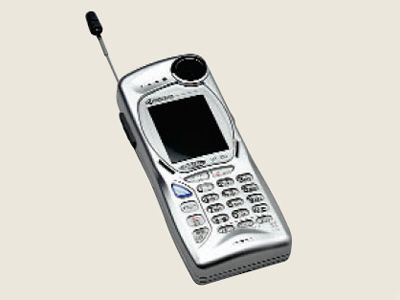
Kyocera Introduces Visual Phone VP-210
Japan
7 min read
Updated By: History Editorial Network (HEN)
Published:
Updated:
In May 1999, Kyocera Corporation announced the Visual Phone VP-210 in Japan, an early commercially available handheld mobile videophone featuring a built-in color camera. Designed for Japan's Personal Handy-phone System (PHS) network, the device combined mobile voice communication, digital photography, and real-time image transmission. Its introduction preceded the widespread commercialization of camera-equipped mobile phones and demonstrated an early application of integrated imaging technology in portable telecommunications equipment.
Kyocera had entered the cellular telephone manufacturing business in 1991, following decades of development in fine ceramics, electronic components, and telecommunications equipment. Founded in Kyoto on 01/04/1959 by Kazuo Inamori and seven partners, the company had diversified into mobile communications during the 1980s and 1990s. Its experience in compact electronics and communications devices provided a foundation for developing a handset that integrated a digital camera with wireless connectivity.
The VP-210 incorporated a front-facing color camera designed to capture still images and support video communication. The camera used a CMOS image sensor with a resolution of approximately 110,000 pixels. The device featured a 2-inch color TFT liquid-crystal display, allowing users to view captured images and display visual information directly on the handset.
One of the VP-210's principal functions was its ability to transmit moving images over a PHS connection. The device supported image transmission at approximately two frames per second, a relatively low frame rate compared with later mobile video technologies. This limitation reflected the bandwidth available through contemporary wireless networks and the processing capabilities of portable devices in the late 1990s.
The handset could also capture and store still photographs. Its internal memory supported approximately 20 images, allowing users to take pictures without carrying a separate digital camera. Images could be transmitted to compatible devices or used in supported communications services. These capabilities brought together functions that had previously been associated with separate cameras, electronic organizers, and mobile telephones.
The VP-210 was developed for Japan's PHS network, a digital wireless telecommunications system that had entered commercial operation in 1995. PHS supported voice calls and data communication through networks of relatively small base stations. Kyocera used these capabilities to develop a device that could exchange visual information during mobile communication.
Kyocera announced the VP-210 on 17/05/1999 and released it commercially in July 1999. The handset was priced at approximately ¥40,000 in Japan. Its introduction took place before camera-equipped mobile phones became common consumer products, including the Sharp J-SH04, which was introduced in Japan in November 2000 with an integrated camera and mobile image-messaging functions.
The VP-210 was not a modern smartphone in the contemporary sense. It operated within the technical limits of late-1990s PHS networks and had a small display, limited image storage, and low-frame-rate video transmission. Nevertheless, it combined a built-in digital camera, portable display, and wireless communications functions in a commercially available handheld device.
#Kyocera
#VP210
#VisualPhone
#CameraPhoneHistory
Primary Reference
Kyocera

Explore the Life Moments of
 AI Twin