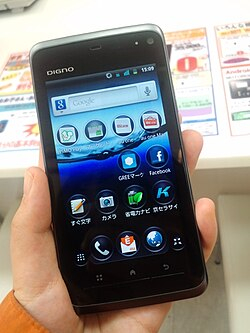
Kyocera Introduces Brigadier Rugged Smartphone
Japan
9 min read
Updated By: History Editorial Network (HEN)
Published:
Updated:
In 2014, Kyocera Corporation introduced the Brigadier, a rugged Android smartphone featuring a sapphire crystal display cover, for the United States market through Verizon Wireless. Announced on 31/07/2014, the handset combined a scratch-resistant display surface with a reinforced body designed to withstand water, dust, drops, and demanding outdoor conditions. The Brigadier extended Kyocera's mobile phone business into a product category focused on durability and practical use in challenging environments.
Kyocera had entered cellular telephone manufacturing in 1991 and subsequently expanded its mobile communications operations through acquisitions in the United States and Japan. In February 2000, it acquired Qualcomm's terrestrial mobile handset business and established Kyocera Wireless Corporation in San Diego, California. In April 2008, it acquired Sanyo Electric's mobile phone business. These developments contributed to Kyocera's engineering and manufacturing capabilities in mobile devices.
The Brigadier was developed for users requiring a smartphone capable of operating in environments where conventional devices might be exposed to moisture, dirt, vibration, or accidental impacts. It was marketed to customers working outdoors and in industrial settings, as well as consumers participating in recreational activities.
Sapphire Shield Display Technology
A defining feature of the Brigadier was its Sapphire Shield display, which used a sapphire crystal cover over the touchscreen. Synthetic sapphire is a form of crystalline aluminum oxide valued for its hardness and resistance to scratching. It is used in applications such as watch crystals, optical components, and protective surfaces.
Kyocera applied this material to the Brigadier's display to reduce the likelihood of scratches caused by contact with hard objects. The sapphire cover was paired with a 4.5-inch HD touchscreen, providing a resolution of 1280 × 720 pixels.
The sapphire display did not make the smartphone indestructible. Scratch resistance and resistance to impact damage are different material properties, and a hard surface can still be damaged by sufficiently severe impacts. The Brigadier's durability therefore depended on its overall construction as well as its display cover.
Rugged Construction and Technical Features
The Brigadier was designed to meet IP68 water and dust resistance requirements and was tested against selected conditions associated with the U.S. military's MIL-STD-810G standard. Its construction was intended to provide protection against environmental exposure and accidental handling damage.
The handset incorporated a 2.3 GHz quad-core Qualcomm Snapdragon 400 processor, 2 GB of RAM, and 16 GB of internal storage. It ran Android 4.4 KitKat and supported Verizon's 4G LTE network.
Its camera system included an 8-megapixel rear camera and a 2-megapixel front-facing camera. The device also included a 3,100 mAh battery and supported wireless charging, features intended to provide practical functionality alongside its rugged design.
The Brigadier incorporated Kyocera's Smart Sonic Receiver technology, which transmitted sound through vibrations in the display area rather than relying solely on a conventional earpiece speaker. This approach was intended to improve voice communication in noisy environments.
United States Launch
Kyocera announced the Brigadier in partnership with Verizon Wireless on 31/07/2014, and the smartphone became available in the United States in August 2014. Verizon offered the device through its retail and online sales channels.
At launch, the Brigadier was priced at approximately US$399.99 without a contract, with subsidized pricing options available through Verizon. Its positioning emphasized durability, water resistance, and scratch resistance rather than competing primarily on display size or camera performance.
The Brigadier was part of Kyocera's broader rugged handset strategy, which included devices designed for users working in construction, transportation, emergency services, and other environments where exposure to water, dust, or physical impacts could affect electronic equipment.
#Kyocera
#KyoceraBrigadier
#SapphireShield
#RuggedSmartphone
Primary Reference
Kyocera

Explore the Life Moments of
 AI Twin