Kyocera Develops an Early Laptop Computer
Japan
8 min read
Updated By: History Editorial Network (HEN)
Published:
Updated:
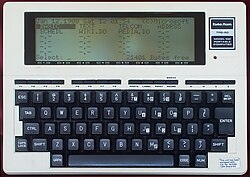
In 1983, Kyocera Corporation developed the Kyotronic 85, an early battery-powered portable computer that was subsequently marketed internationally under several different brand names, including the Radio Shack TRS-80 Model 100. The compact computer combined a built-in keyboard, liquid-crystal display, battery operation, and integrated software in a portable design. Its development extended Kyocera's activities beyond advanced ceramic components into the manufacture of complete personal computing devices.
Kyocera Corporation, originally founded as Kyoto Ceramic Co., Ltd. on 01/04/1959 by Kazuo Inamori and seven partners, had built its early business around fine ceramic materials used in television equipment, computers, and industrial electronics. During the 1970s, the company diversified into electronic devices and telecommunications-related products. Its development of the Kyotronic 85 reflected this broader involvement in finished electronic equipment.
The Kyotronic 85 used an 8-bit processor from the Intel 8085 family and incorporated a liquid-crystal display capable of showing eight lines of 40 characters. It included a full-size keyboard and software stored in read-only memory, allowing users to perform basic computing tasks without loading programs from external disks. The system supported functions such as text editing, BASIC programming, and personal information management.
One of the computer's defining characteristics was its portability. Unlike many desktop computers of the early 1980s, which required an external monitor and a continuous electrical supply, the Kyotronic 85 could operate on ordinary batteries. Its compact, integrated construction allowed users to work away from a fixed office or home computing environment. This made the design suitable for activities such as writing, note-taking, and working with information while traveling.
The computer became better known internationally through versions distributed by other companies. In the United States, Tandy Corporation marketed the design as the Radio Shack TRS-80 Model 100, introduced in 1983. Other related versions included the NEC PC-8201 and Olivetti M-10, although the machines differed in certain design and software details. These commercial relationships brought Kyocera's portable computer platform to customers through established electronics brands.
The TRS-80 Model 100 was particularly associated with journalists, writers, and professionals who needed portable text-entry equipment. Its keyboard, battery operation, built-in text editor, and ability to store documents made it useful for preparing written material outside a traditional office. With suitable telecommunications equipment and connections, users could also transmit files or text remotely, supporting workflows such as submitting reports from locations away from a newsroom.
The software environment associated with the Model 100 family included contributions from Microsoft. Its built-in applications included BASIC and productivity software developed for the platform. The system is also associated with Bill Gates, who participated in Microsoft's early software development activities for the machine.
The Kyotronic 85 and its related commercial versions appeared during a period when personal computing manufacturers were experimenting with smaller and more portable designs. Although these machines did not use the hinged display arrangement that later became common in notebook computers, they demonstrated how a computer could combine a keyboard, screen, software, and independent power supply in a single portable unit.
#Kyocera
#Kyotronic85
#TRS80Model100
#PortableComputer
Primary Reference
Kyocera

Explore the Life Moments of
 AI Twin