Successor to Bayer Filter Created
United States
Digital Imaging
Camera Technology
Image Processing
6 min read
Updated By: History Editorial Network (HEN)
Published:
Updated:
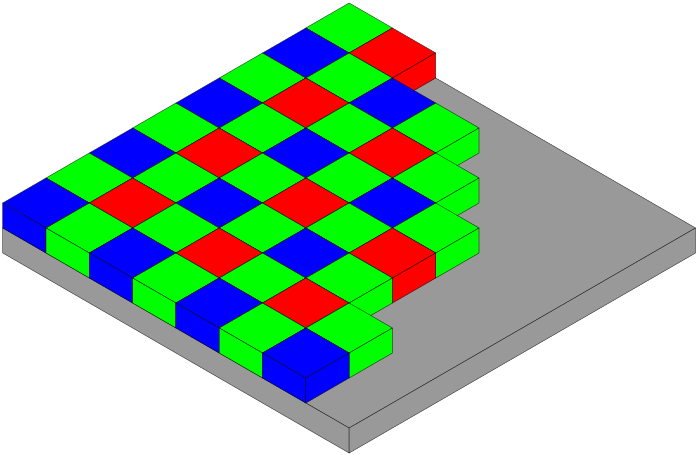
The Bayer filter, developed by Eastman Kodak scientist Bryce Bayer in the mid-1970s, introduced a practical method for capturing color images with a single image sensor and became one of the foundational technologies in digital photography. Working at Kodak Research Laboratories, Bayer designed a color filter array that placed red, green, and blue filters in a repeating mosaic pattern over a sensor. His concept was documented in 1974, and Kodak filed a patent application in March 1975. The invention was later granted as U.S. Patent No. 3,971,065 on 20/07/1976.
The filter's design used twice as many green elements as red or blue elements because human vision is more sensitive to luminance information carried largely through the green channel. This arrangement allowed a single sensor to capture enough color information for image reconstruction through a process later known as demosaicing. The Bayer pattern offered a simpler and more cost-effective alternative to multi-sensor camera systems, helping manufacturers build smaller and more affordable digital cameras.
The technology moved from research into commercial products during the early years of digital photography. Kodak's digital camera systems in the early 1990s incorporated Bayer filter arrays, and the design rapidly became the dominant standard across the imaging industry. Today, variations of the Bayer pattern are used in most consumer digital cameras, smartphones, webcams, camcorders, and drone cameras. Industry experts have estimated that the overwhelming majority of color digital cameras rely on Bayer-based color filter arrangements.
As image sensor technology evolved, engineers identified limitations associated with the traditional Bayer design. Because each sensor pixel records only one color component, software interpolation is required to generate a full-color image. This process can introduce artifacts, reduce color precision in certain situations, and affect performance in very low-light environments. These challenges encouraged research into alternative sensor architectures, including RGBW designs, Quad Bayer arrangements, Foveon-type sensors, and other advanced color filter arrays intended to improve sensitivity, noise performance, and color reproduction.
Why This Moment Matters
Bryce Bayer's invention provided a practical framework for color image capture at a time when digital photography was still in its early stages. Although newer sensor technologies continue to emerge, the Bayer filter remains embedded in the design of modern imaging systems and continues to influence how billions of digital photographs are captured and processed each year.
#BayerFilter #BryceBayer #DigitalPhotography #ImageSensors #Kodak #CameraTechnology #DigitalImagin
#mooflife
#MomentOfLife
#BayerFilter
#DigitalCameras
#ImageSensors
#Kodak
#RgbColorDisplay
Primary Reference
Bayer_filter

Explore the Life Moments of
 AI Twin