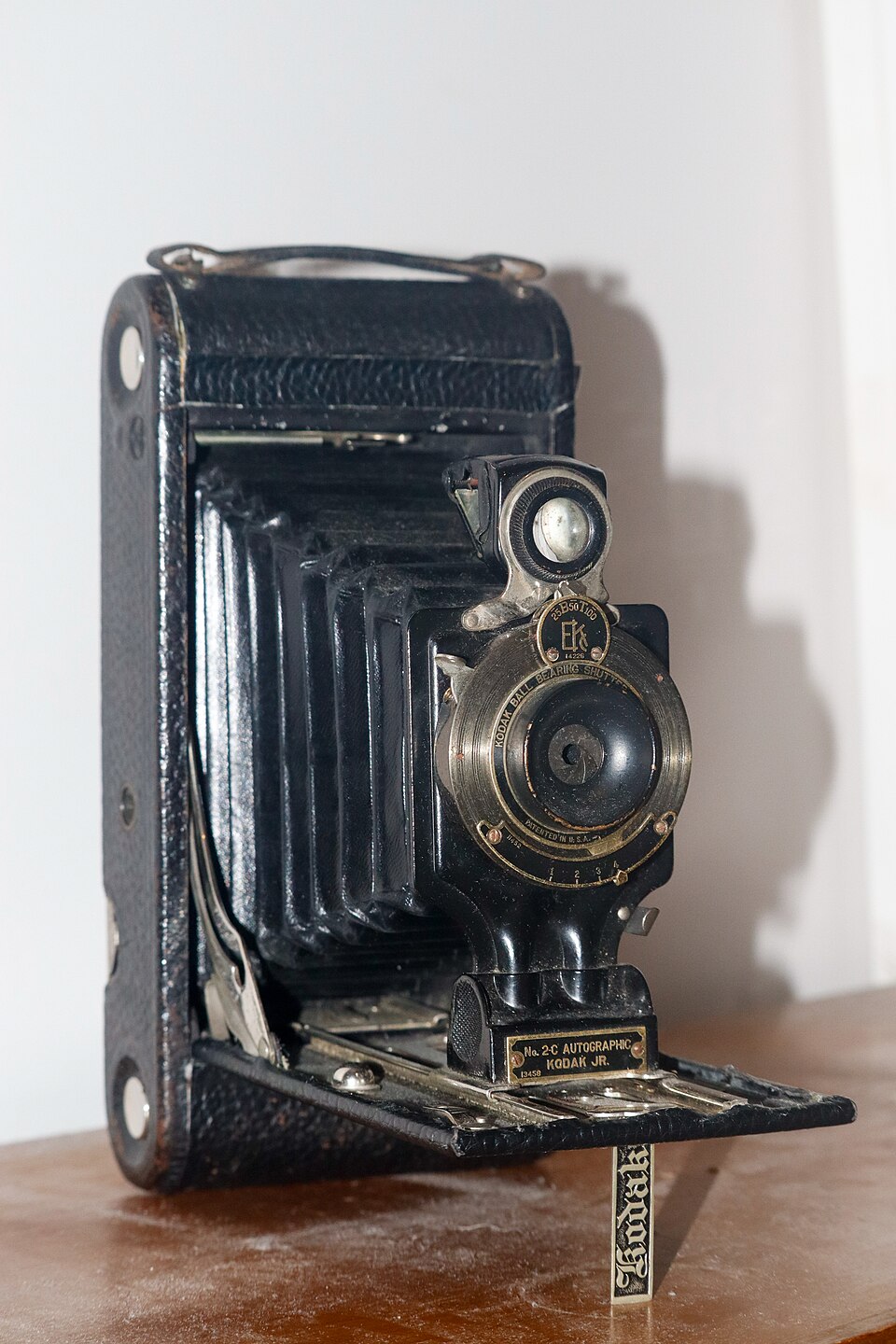
No. 2C Autographic Kodak Junior Folding Camera and Kodak’s Early Autographic Film Era
United States
6 min read
Updated By: History Editorial Network (HEN)
Published:
The No. 2C Autographic Kodak Junior was a folding roll film camera produced by the Eastman Kodak Company in Rochester, New York, during the 1910s and 1920s. Most documented examples place its production period between 1916 and 1927. The camera was part of Kodak’s Autographic line, a series designed to let photographers write notes directly onto the film at the time a photograph was taken.
Built with a folding bellows design and covered in leather, the No. 2C Autographic Kodak Junior was intended for amateur photographers who wanted a portable camera with more flexibility than the basic box cameras of the period. Features commonly found on the model included a reversible finder, adjustable focus, tripod sockets, and a Kodak ball-bearing shutter. Versions were sold with different lens options, including meniscus and Kodak Anastigmat lenses. The camera used Kodak A130 Autographic roll film, which was specifically made for the Autographic system.
Kodak introduced the Autographic film system in 1914 after acquiring rights to the invention developed by Henry Jacques Gaisman. The technology allowed photographers to open a small door on the back of the camera and use a metal stylus to write information such as dates, locations, or descriptions directly onto the film backing. After processing, these notes appeared alongside the image. Kodak marketed the feature as a practical way to preserve details about photographs long before digital metadata existed.
The No. 2C Autographic Kodak Junior reflected Kodak’s broader effort to make photography more accessible during the early twentieth century. Folding cameras like this offered larger image formats while remaining compact enough for travel. Although the Autographic system gradually declined in popularity during the 1920s and was eventually discontinued in 1932, surviving cameras remain of interest to collectors and photography historians because they document an early attempt to combine image capture with written photographic records.
Historical Significance
The No. 2C Autographic Kodak Junior represents a transitional period in consumer photography when manufacturers were experimenting with ways to attach contextual information to photographs. Its Autographic feature can be viewed as an early analogue predecessor to the date stamps, captions, and metadata that later became standard in modern photography systems.
#Kodak #VintageCamera #AutographicKodak #FilmPhotography #EastmanKodak #PhotographyHistory #FoldingCamera
Primary Reference
Kodak

Explore the Life Moments of
 AI Twin