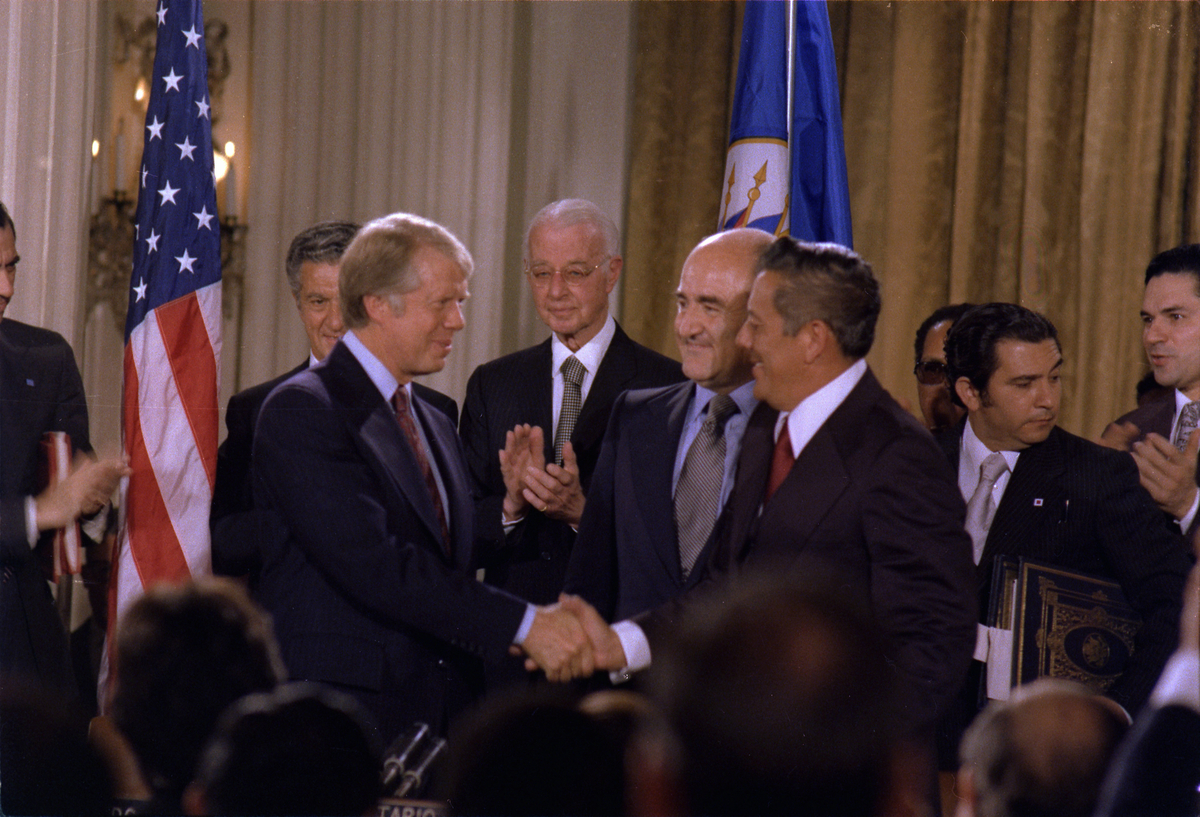
Agreement reached for Panama Canal transfer to Panama.
Political
Global Trade
5 min read
Updated By: History Editorial Network (HEN)
Published:
On September 7, 1977, Jimmy Carter, then President of the United States, participated in a pivotal event involving the signing of the Panama Canal Treaties. These treaties represented a considerable shift in U.S. foreign policy and were the result of extensive negotiations between the United States and Panama. The primary objective was to transfer control of the Panama Canal from the U.S. to Panama, ensuring Panamanian sovereignty over the territory.
The two treaties were the Torrijos-Carter Treaties, named after President Carter and General Omar Torrijos of Panama. The first treaty, known as the Panama Canal Treaty, outlined the gradual transfer of canal control to Panama by December 31, 1999. The second treaty, the Neutrality Treaty, established that the canal would remain neutral in times of peace and war, ensuring passage for ships from any nation.
Background tensions had been building for years, as many in Panama viewed the 1903 treaty, which originally granted the U.S. rights to the canal zone, as outdated and a relic of colonialism. The transfer was symbolic of a move towards greater fairness and respect for national sovereignty.
The treaties faced considerable opposition in the United States. Critics argued that giving up control of the strategically crucial canal would weaken American influence and security. Despite this, President Carter believed that the treaties were essential to improving relations with Latin American countries and lessening anti-American sentiments.
The Senate ratified the treaties after intense debate and several amendments, requiring a two-thirds majority. The first treaty passed with a 68-32 vote, and the Neutrality Treaty with a 68-32 vote as well. Numerous operational and economic implications stemmed from the treaties. The canal was, and remains, a vital artery for international maritime trade, contributing significantly to global shipping efficiency.
The completion of the transfer process culminated in Panama taking full control of the canal in 1999. Today, the Panama Canal remains a critical component of global trade and a symbol of international cooperation.
#PanamaCanalTreaties #USForeignPolicy #JimmyCarter #InternationalRelations #MoofLife
Primary Reference
The Panama Canal and the Torrijos-Carter Treaties
Explore the Life Moments of
 AI Twin