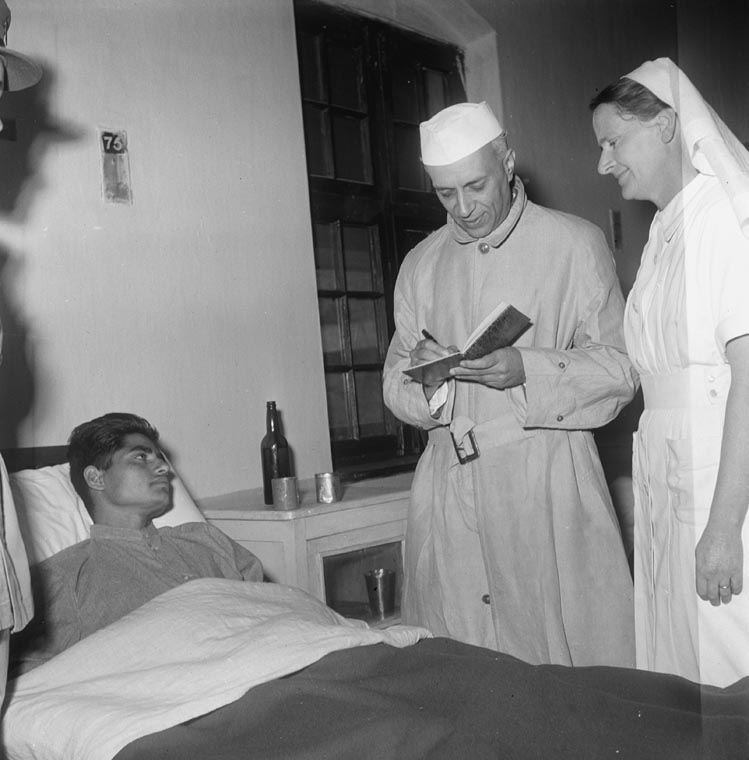
Jawaharlal Nehru's Visit to Troops in Srinagar during Indo-Pakistani War: A Symbol of Commitment.
India
Political
4 min read
Updated By: History Editorial Network (HEN)
Published:
Updated:
Jawaharlal Nehru's visit to the troops in Srinagar occurred during the Indo-Pakistani War, a conflict over the princely state of Jammu and Kashmir. The partition of British India into India and Pakistan led to disputes over several regions, with Kashmir being the most contentious. Following the accession of Maharaja Hari Singh to India, Pakistan launched a military campaign to take control of the region.
Nehru's presence in Srinagar symbolized a commitment to defend Kashmir against the incursions. It was a critical move, aimed at boosting the morale of Indian soldiers and reassuring the local population of India's dedication to maintaining security and sovereignty over the region. The Indian government's strategic and diplomatic efforts focused on integrating Kashmir and addressing the complex political dynamics resulting from the invasion.
This visit reinforced the resolve of Indian forces, who had been engaged in intense combat with Pakistani troops and tribal militias. The conflict saw numerous battles and skirmishes across the mountainous terrain, resulting in substantial casualties on both sides.
Nehru's reaffirmation of military and political support was an essential aspect of India's broader efforts to stabilize Kashmir. It involved not just military action but also diplomatic maneuvers on the international stage, which included appealing to the United Nations for intervention.
His visit highlighted the importance of leadership visibility in wartime and underlined India's stance on Kashmir. This event is a reflection of the broader geopolitical struggle in the subcontinent, set against the backdrop of newly independent nations defining their boundaries and spheres of influence.
#JawaharlalNehru #IndoPakistaniWar #KashmirConflict #IndianArmy #LeadershipInWar #DefensePolicy #MoofLife
Explore the Life Moments of
 AI Twin