2010 Kingston unrest
Jamaica

Political
Unrest
CivilUnrest
9 min read
Updated By: History Editorial Network (HEN)
Published:
The 2010 Kingston unrest was a significant and violent episode in Jamaica's recent history, rooted in the long-standing issues of crime, politics, and social inequality. The unrest was sparked by the Jamaican government's decision to arrest and extradite Christopher "Dudus" Coke, a powerful and feared drug lord and the leader of the Shower Posse, a notorious gang with deep ties to the community of Tivoli Gardens in West Kingston, and extensive criminal networks in the United States.
Christopher Coke, often referred to simply as "Dudus," was not just a criminal; he was a figure who embodied the complex relationship between politics and crime in Jamaica. Dudus had inherited his position from his father, Lester Lloyd Coke, also known as "Jim Brown," who had also led the Shower Posse. The gang, notorious for its involvement in drug trafficking and gun-running, had a fearsome reputation in both Jamaica and the United States.
However, Dudus was also seen as a protector and benefactor in Tivoli Gardens. He provided financial support, jobs, and social services to the residents, filling a void left by the government. This earned him the loyalty and even adoration of many in the community, making him a formidable figure in Jamaican society.
The trouble began when the United States requested Dudus's extradition on charges of drug trafficking and gun-running. The Jamaican government, led by Prime Minister Bruce Golding, initially hesitated to comply, citing concerns over the legality of the wiretap evidence provided by the U.S. This delay raised suspicions about the influence of Dudus and the Shower Posse on Jamaican politics, as Golding was the Member of Parliament for West Kingston, which included Tivoli Gardens.
Under mounting international pressure and increasing criticism at home, Golding eventually agreed to the extradition request in May 2010. This decision set the stage for a confrontation, as Dudus's supporters in Tivoli Gardens and elsewhere vowed to protect him at all costs.
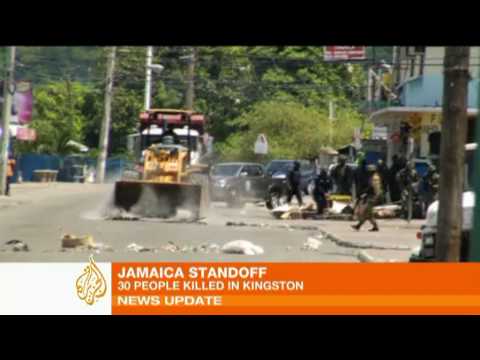
The Jamaican government's move to arrest Dudus triggered a violent response. On May 23, 2010, the government declared a state of emergency in Kingston and St. Andrew, covering Tivoli Gardens. Security forces, including the Jamaican Defence Force (JDF) and the Jamaican Constabulary Force (JCF), were deployed in large numbers to apprehend Dudus.
What followed was a brutal and bloody conflict. Tivoli Gardens was transformed into a war zone as heavily armed gang members fortified the area and engaged in fierce battles with the security forces. The residents, many of whom were loyal to Dudus, were caught in the crossfire.
The operation lasted several days, during which the security forces were accused of using excessive force, leading to significant civilian casualties. Official reports stated that at least 73 people were killed, although some sources claim the number was higher. The Jamaican government later faced serious criticism for the way the operation was conducted, with allegations of extrajudicial killings and human rights abuses.
On June 22, 2010, Dudus was finally captured by the Jamaican authorities, ending a month-long manhunt. Disguised in a wig and women's clothing, he was apprehended on the Mandela Highway and later extradited to the United States, where he was tried and sentenced to 23 years in prison on drug trafficking charges.
The 2010 Kingston unrest left a deep scar on Jamaica. It exposed the deep-rooted issues of poverty, crime, and the complicated ties between politics and criminal organizations in the country. The event also raised serious questions about the conduct of the Jamaican security forces and the government's commitment to human rights.
In the years that followed, the Jamaican government attempted to address some of the underlying issues, including launching investigations into the conduct of the security forces during the operation. However, for many in Tivoli Gardens and the wider Jamaican society, the events of May 2010 are a stark reminder of the challenges the country faces in dealing with crime, corruption, and social inequality.
#KingstonUnrest #ChristopherDudusCoke #JamaicanHistory #MomentsOfLife #MoofLife_Moment #MoofLife
Primary Reference
2010 Kingston unrest - Wikipedia

Explore the Life Moments of
 AI Twin