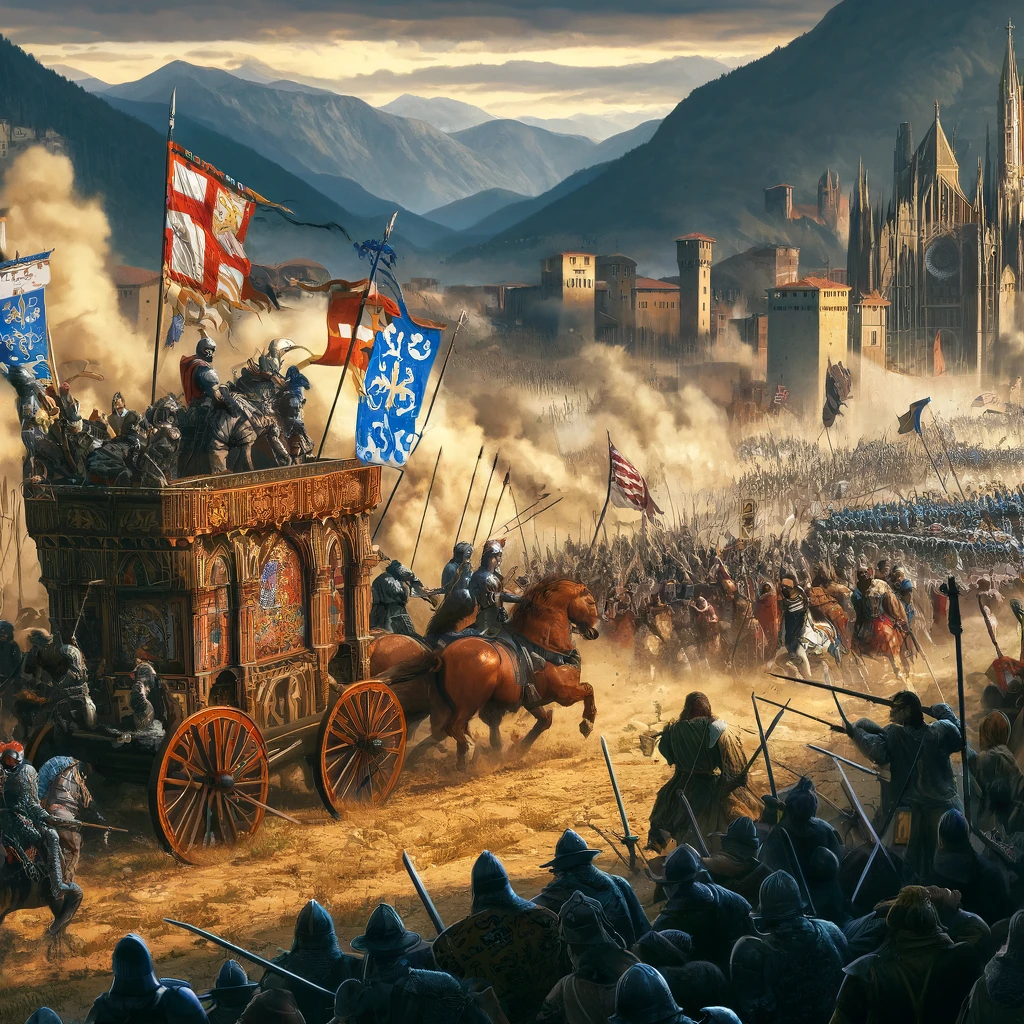
Lombard League triumphs over Emperor Frederick Barbarossa, securing northern Italian city independence.
Italy
Political
8 min read
Updated By: History Editorial Network (HEN)
Published:
On May 29, 1176, the Lombard League achieved a significant victory over Emperor Frederick I, commonly known as Frederick Barbarossa, in the Battle of Legnano. This triumph was pivotal in securing the independence of the northern Italian city-states, marking a crucial moment in the power dynamics between the Holy Roman Empire and the Italian municipalities.
The conflict between Frederick Barbarossa and the Lombard League was rooted in the emperor's ambitions to consolidate his control over the prosperous and strategically vital northern Italian cities. These cities, however, were fiercely protective of their autonomy and economic independence. In response to Frederick’s aggressive policies and repeated military campaigns aimed at subjugating them, a coalition of northern Italian city-states formed the Lombard League in 1167. This alliance included prominent cities like Milan, Venice, Bologna, and Parma, united in their determination to resist imperial dominance.
Frederick Barbarossa, known for his formidable military prowess and political acumen, had launched multiple expeditions into Italy to assert his authority. Despite initial successes, his campaign faced staunch resistance from the Lombard League, culminating in the decisive confrontation at Legnano, near Milan.
The Battle of Legnano was a defining moment. On this fateful day, the Lombard League forces, composed largely of militia from various member cities, faced Frederick’s well-equipped and experienced imperial army. The League's troops were bolstered by their strong resolve to defend their liberties and communal freedoms. The battle was intense and brutal, with both sides enduring heavy casualties. However, the strategic acumen and sheer determination of the Lombard forces ultimately led to their victory.
A key element of the Lombard League’s success was their use of the carroccio, a large ceremonial wagon that served as a mobile altar and a rallying point for their troops. This symbol of unity and defiance inspired the soldiers to fight with unwavering courage. Frederick Barbarossa himself narrowly escaped capture or death during the chaotic retreat of his forces.
The aftermath of the Battle of Legnano had profound implications. The defeat significantly weakened Frederick Barbarossa’s position in Italy, forcing him to reconsider his approach to the rebellious cities. In 1177, a year after his defeat, the Treaty of Venice was negotiated, leading to a truce and eventually, the Peace of Constance in 1183. This peace agreement granted the Lombard League cities significant concessions, including the right to elect their own magistrates, maintain their own laws, and manage their internal affairs with minimal imperial interference, while still acknowledging Frederick as their nominal overlord.
The victory of the Lombard League at Legnano is celebrated as a milestone in the history of Italian communal independence. It not only curtailed the ambitions of a powerful emperor but also laid the groundwork for the flourishing of the city-states that would later contribute to the Renaissance. This event is remembered as a testament to the power of unity and collective resistance against oppression.
The Battle of Legnano is commemorated annually on May 29th, symbolizing the enduring spirit of freedom and self-governance that characterized the Italian city-states. It remains a significant historical moment, illustrating the complexities of medieval European politics and the relentless quest for autonomy by the Italian municipalities.
#MomentsOfLife #MoofLife_Moment #MoofLife #LombardLeague #FrederickBarbarossa #BattleOfLegnano #ItalianIndependence #MedievalHistory #CityStates #PeaceOfConstance
Primary Reference
Battle of Legnano - Wikipedia

Explore the Life Moments of
 AI Twin