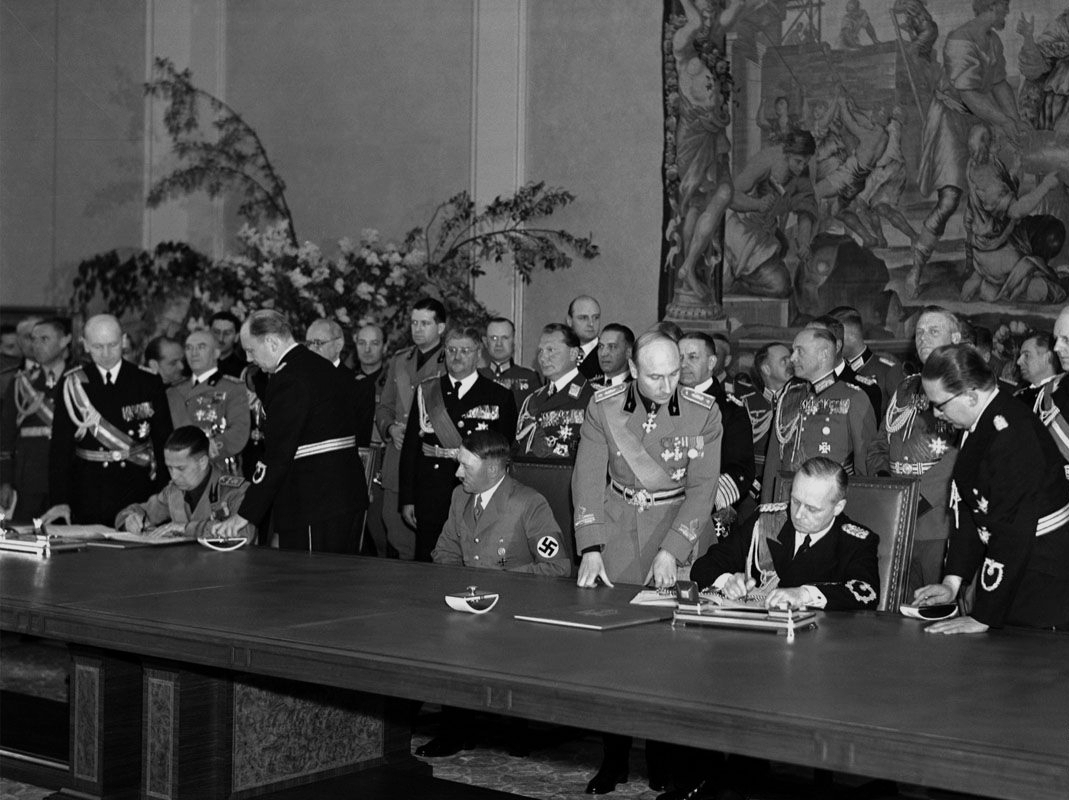
Italy signs the Pact of Steel, a military alliance with Germany
Italy
Political
Global Trade
10 min read
Updated By: History Editorial Network (HEN)
Published:
In May 1939, the political landscape of Europe shifted significantly when Italy and Germany formalized their military alliance by signing the Pact of Steel. This agreement, officially known as the "Pact of Friendship and Alliance between Germany and Italy," was signed on May 22, 1939, by the foreign ministers of the two nations: Galeazzo Ciano for Italy and Joachim von Ribbentrop for Germany. This moment solidified the Axis Powers' foundation and marked a crucial step towards the outbreak of World War II.
Background and Context
The 1930s were characterized by rising tensions and the aggressive expansionist policies of several nations, particularly Germany and Italy. Adolf Hitler’s Germany had already taken bold steps in defying the Treaty of Versailles by rearming and expanding its territory through the annexation of Austria (Anschluss) in 1938 and the occupation of Czechoslovakia in early 1939. Italy, under Benito Mussolini, pursued its imperial ambitions by invading Ethiopia in 1935 and establishing control over Albania in April 1939.
Both nations found common ground in their authoritarian ideologies and mutual interests in territorial expansion. Their relationship had been growing closer since the mid-1930s, marked by agreements such as the Rome-Berlin Axis in 1936, which was more of a political understanding than a formal alliance. However, the need for a stronger military alliance became apparent as Europe edged closer to war.
The Signing of the Pact
The Pact of Steel consisted of two parts: a declaration of trust and cooperation between Germany and Italy, and a secret supplementary protocol outlining mutual military assistance. The public part of the treaty emphasized the enduring friendship and shared interests between the two nations, while the secret protocol committed each signatory to come to the other’s aid immediately in the event of war, be it offensive or defensive.
The signing ceremony took place in Berlin, with significant pomp and ceremony, underscoring the importance both nations placed on this alliance. For Italy, the pact was intended to secure its position alongside Germany and to ensure support in its Mediterranean and African ambitions. For Germany, the alliance provided strategic advantages, reinforcing its southern flank and gaining a valuable partner in its plans for European domination.
Implications of the Pact
The Pact of Steel had several immediate and long-term implications:
Military Coordination: The pact required Italy and Germany to coordinate their military strategies and operations, effectively binding their war efforts together. This was intended to present a united front against the Allied powers and to streamline their military planning.
Political and Diplomatic Impact: The pact alarmed other European nations and contributed to the increasing polarization of Europe into two hostile blocs. It made clear that Germany and Italy were preparing for a major conflict and that their ambitions would not be constrained by diplomatic negotiations or existing treaties.
Economic Collaboration: The alliance also implied closer economic cooperation, particularly in terms of war production and resource allocation. This was crucial for both countries as they prepared for the resource-intensive demands of large-scale warfare.
Influence on Subsequent Alliances: The Pact of Steel set a precedent for further military alliances, most notably influencing the eventual signing of the Tripartite Pact in 1940, which included Japan and formally established the Axis Powers.
Consequences and Historical Significance
The Pact of Steel represented the culmination of the growing ideological and strategic partnership between Fascist Italy and Nazi Germany. However, it also highlighted significant differences between the two regimes, particularly in terms of their military readiness and strategic objectives. Italy was not as prepared for a prolonged conflict as Germany, a factor that would become painfully evident as World War II progressed.
The alliance tied Italy’s fortunes to those of Germany, leading to Italy’s involvement in numerous military campaigns alongside German forces. As the war dragged on, the disparity in the capabilities and priorities of the two allies created tensions. Mussolini’s aspirations for Mediterranean dominance often clashed with Hitler’s focus on Eastern Europe and the Soviet Union.
Ultimately, the Pact of Steel can be seen as both a symbol and a catalyst of the broader conflict that engulfed the world from 1939 to 1945. It underscored the dangerous potential of authoritarian alliances and the lengths to which these regimes would go to achieve their expansionist goals. The alliance’s initial promise of mutual support and cooperation gave way to the harsh realities of war, revealing the inherent weaknesses and divergent aims of the Axis Powers.
#MomentsOfLife #MoofLife_Moment #MoofLife #PactOfSteel #WWII #AxisPowers #ItalyGermanyAlliance #1939History #Mil
Primary Reference
Pact of Steel - Wikipedia

Explore the Life Moments of
 AI Twin