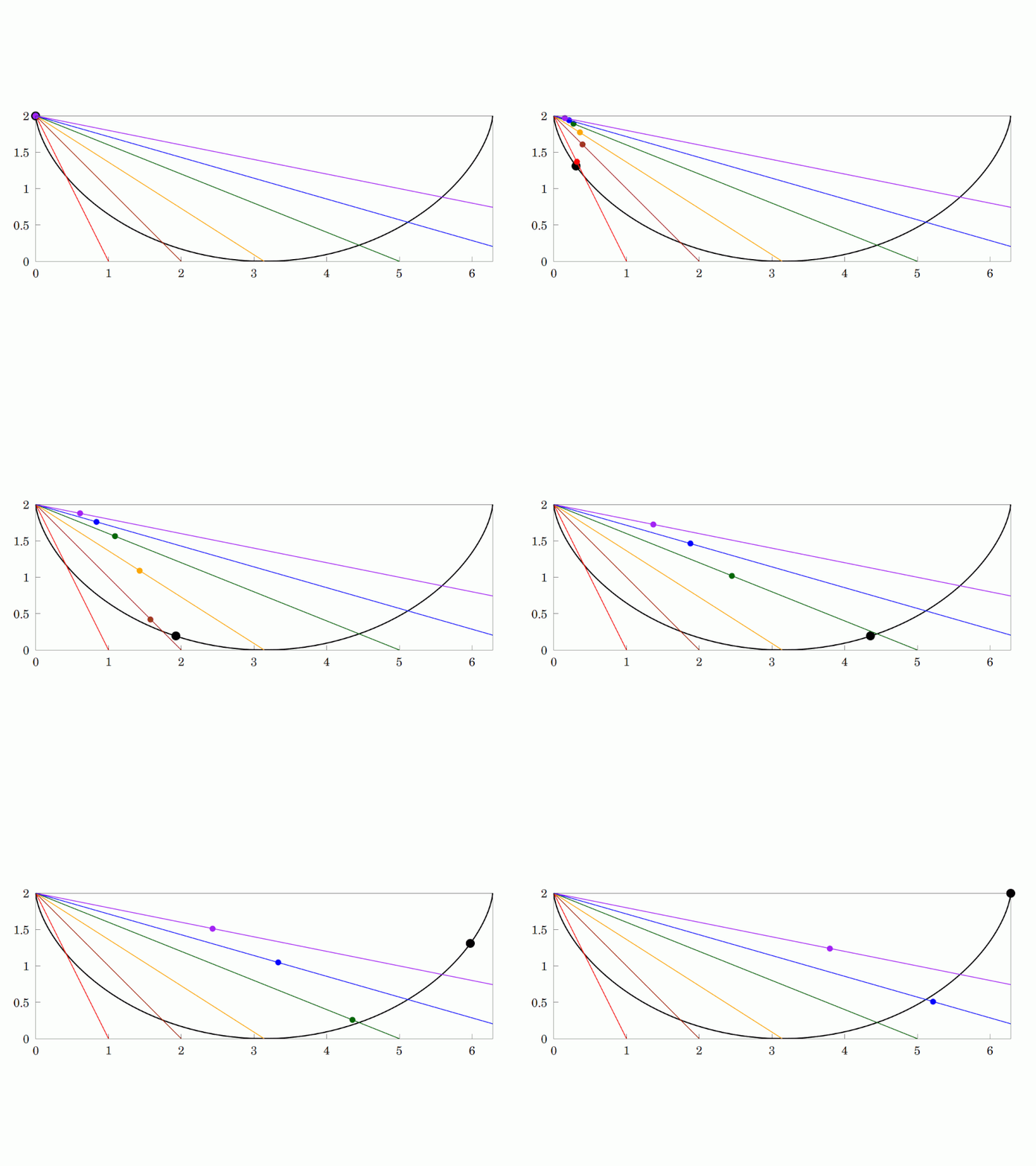
Solving the brachistochrone curve problem
Mathematics
Physics
History of Science
4 min read
Updated By: History Editorial Network (HEN)
Published:
Updated:
The brachistochrone curve problem is a classic problem in the calculus of variations, first posed by mathematician Johann Bernoulli. The problem asks for the shape of a curve down which a bead will slide from one point to another in the least time, under the influence of gravity. This question not only intrigued mathematicians but also laid the groundwork for future studies in physics and engineering. The solution to this problem is a cycloid, the curve traced by a point on the circumference of a circle as it rolls along a straight line. The significance of this problem lies in its application of calculus to real-world scenarios, demonstrating how mathematical principles can be used to solve practical problems in motion and dynamics.
In addressing the brachistochrone curve problem, Isaac Newton employed the calculus of variations, a mathematical method that deals with optimizing functionals, which are mappings from a set of functions to real numbers. Newton's solution to this problem not only showcased his mathematical prowess but also solidified his role as a pioneer in the field of calculus. The impact of this work extended beyond mathematics, influencing the development of physics and engineering principles. The brachistochrone problem remains a fundamental example in the study of optimization and has inspired numerous applications in various fields, including mechanics and control theory. The exploration of such problems has led to advancements in understanding motion, energy conservation, and the principles governing physical systems.
#mooflife
#MomentOfLife
#BrachistochroneCurve
#CalculusOfVariations
#JohannBernoulli
#IsaacNewton
#Mathematics

Explore the Life Moments of
 AI Twin