Newton's Proof of Elliptical Planetary Orbits
Science
Physics
Astronomy
3 min read
Updated By: History Editorial Network (HEN)
Published:
Updated:
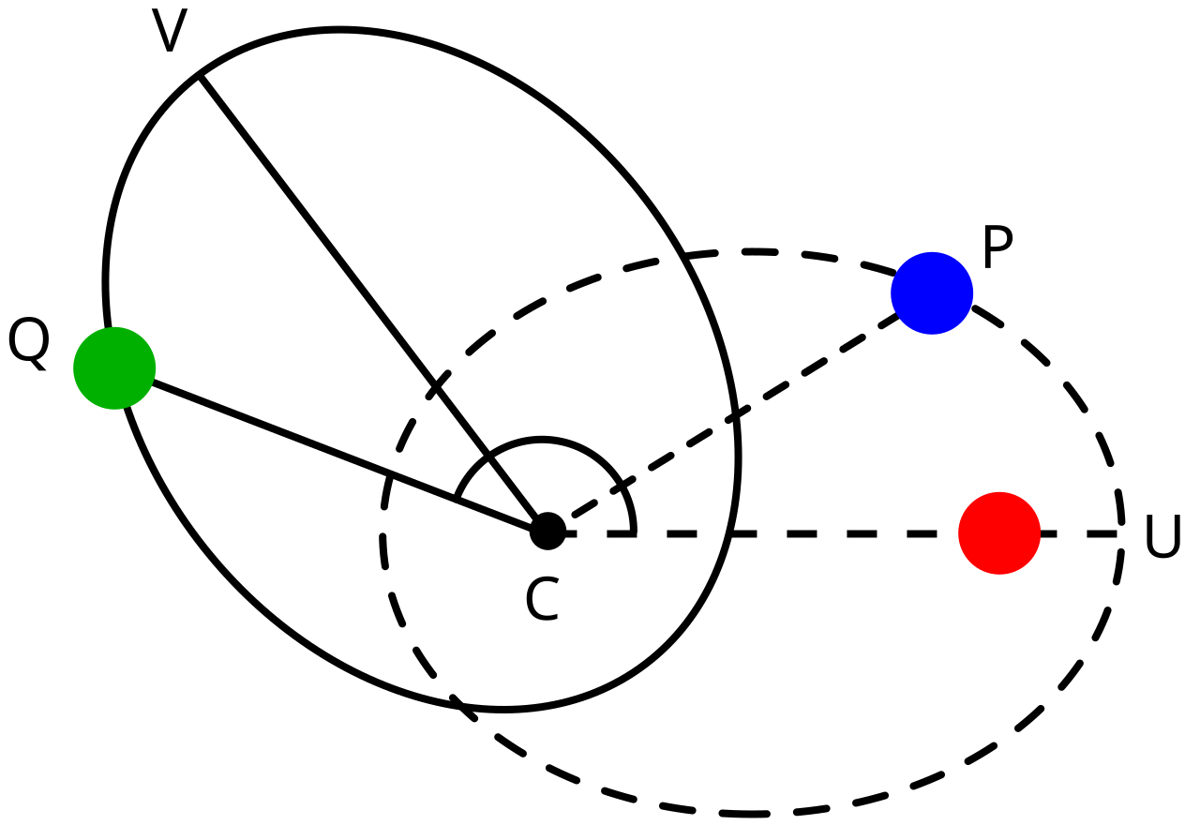
The correspondence between Isaac Newton and Robert Hooke played a crucial role in the development of Newton's proof regarding the elliptical nature of planetary orbits. Hooke, who served as Secretary of the Royal Society, initiated this exchange in an effort to encourage contributions from Newton to the Society's transactions. This interaction, although brief, was significant in prompting Newton to delve deeper into the mechanics of celestial motion. Newton's exploration led him to establish that the elliptical orbits of planets could be explained by a centripetal force that is inversely proportional to the square of the radius vector. This foundational concept not only advanced the understanding of planetary motion but also laid the groundwork for Newton's later work in his seminal publication, 'Philosophiæ Naturalis Principia Mathematica'. The implications of this proof were profound, as they provided a mathematical framework that described the motion of celestial bodies, influencing both astronomy and physics. The acceptance of elliptical orbits challenged previous notions of circular orbits and marked a pivotal shift in the scientific community's understanding of gravitational forces and motion in space. Newton's work ultimately contributed to the establishment of classical mechanics, which would dominate scientific thought for centuries and serve as a basis for future discoveries in both physics and astronomy.
#mooflife
#MomentOfLife
#Newton
#EllipticalOrbits
#PlanetaryMotion
#CentripetalForce
#RoyalSociety
Primary Reference
Newton's theorem of revolving orbits

Explore the Life Moments of
 AI Twin