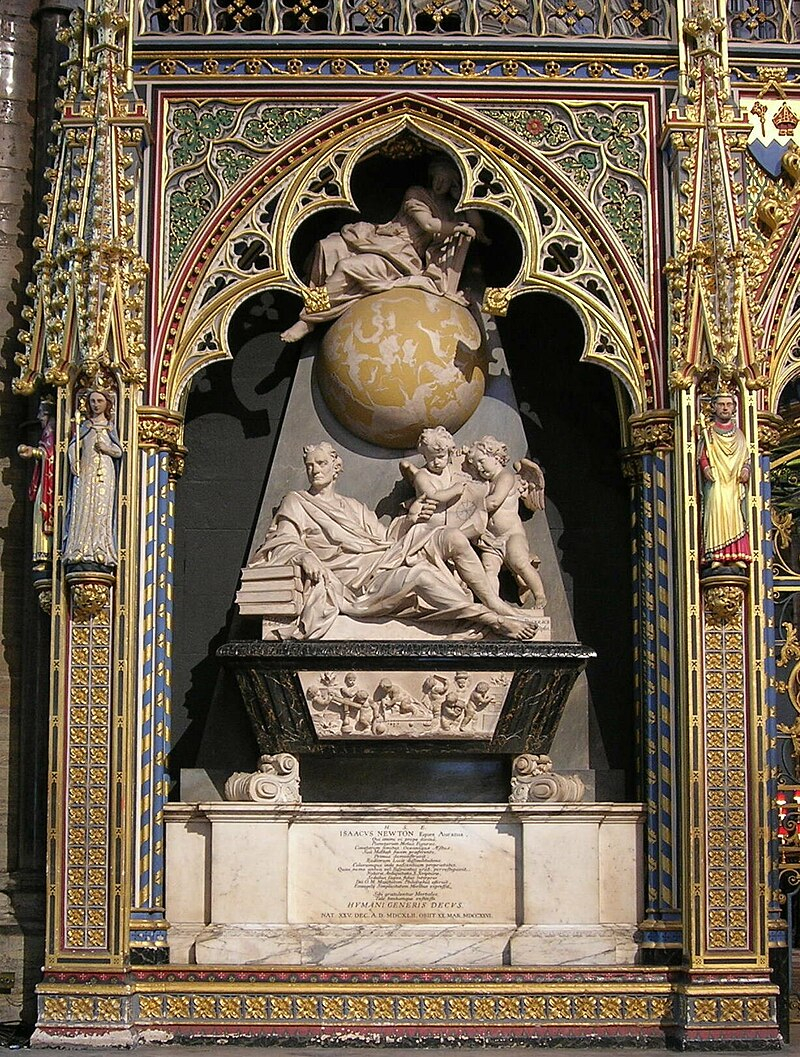
Newton's Monument in Westminster Abbey
Art and Sculpture
Historical Monuments
Science and Innovation
4 min read
Updated By: History Editorial Network (HEN)
Published:
Updated:
Newton's Monument, located in Westminster Abbey, serves as a tribute to one of the most influential scientists in history, Sir Isaac Newton. The monument was executed by the sculptor Michael Rysbrack and designed by William Kent. It features a reclining figure of Newton on a sarcophagus, surrounded by various symbolic elements that represent his contributions to science and mathematics. The placement of the monument is significant, as it is situated near Newton's tomb, emphasizing his importance in the realm of scientific discovery. The monument was completed in the early 18th century and has since become a focal point for visitors to the Abbey, who come to pay their respects to Newton's legacy.
The impact of Newton's work on science is profound, with his laws of motion and universal gravitation laying the groundwork for classical mechanics. His contributions extend beyond physics; he also made significant advancements in mathematics, particularly in calculus. The presence of his monument in Westminster Abbey not only honors his achievements but also reflects the esteem in which he is held in the scientific community. The Abbey itself is a site of national significance, housing the remains of many notable figures in British history, and Newton's inclusion among them underscores the lasting influence of his work on both science and society. The monument continues to inspire future generations of scientists and mathematicians, serving as a reminder of the importance of inquiry and discovery in understanding the natural world.
#mooflife
#MomentOfLife
#Newton'sMonument
#WestminsterAbbey
#MichaelRysbrack
#ScientificLegacy
#IsaacNewton
Primary Reference
Isaac Newton

Explore the Life Moments of
 AI Twin