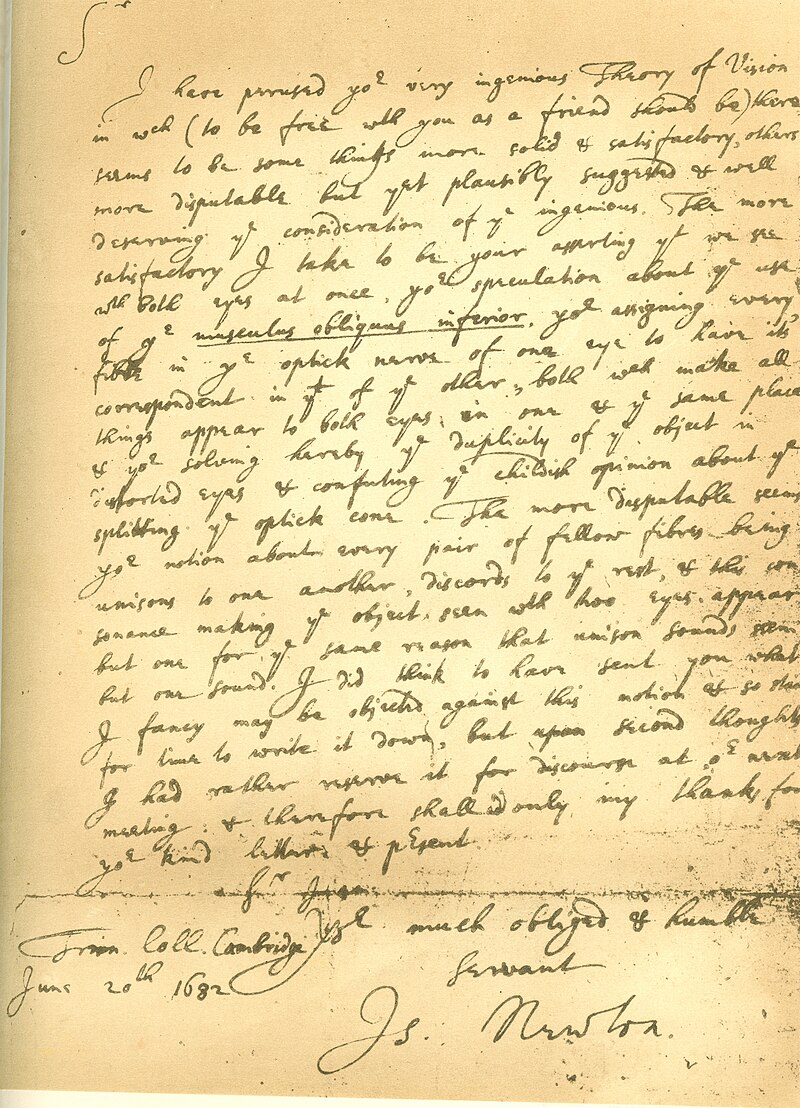
Newton's Letter to William Briggs
Physics
Optics
History of Science
4 min read
Updated By: History Editorial Network (HEN)
Published:
Updated:
In a letter to William Briggs, Isaac Newton discussed his theories on the nature of light, emphasizing his belief that light is composed of particles, or corpuscles. He explained that these particles are refracted when they enter a denser medium, which is a fundamental concept in optics. Newton's correspondence highlighted his exploration of the behavior of light, particularly in relation to reflection and transmission through thin films. He acknowledged the complexity of light's behavior, suggesting that it exhibited both particle-like and wave-like properties. This duality was a precursor to the later scientific understanding of wave-particle duality, which became a cornerstone of modern physics. Newton's work in this area was significant in shaping the field of optics and laid the groundwork for future research into the nature of light.
The impact of Newton's theories extended beyond his immediate correspondence with Briggs. His insights into the behavior of light contributed to the development of optical instruments and the study of color. Newton's particle theory of light, while initially dominant, coexisted with wave theories that emerged later. His acknowledgment of light's dual nature foreshadowed the complexities that would be explored in quantum mechanics. The discussions in his letter reflect a critical period in scientific thought, where empirical observation began to challenge established notions of physics. Newton's contributions to optics not only influenced his contemporaries but also set the stage for future advancements in the understanding of light and its properties.
#mooflife
#MomentOfLife
#IsaacNewton
#WilliamBriggs
#Optics
#LightTheory
#Wave-particleDuality

Explore the Life Moments of
 AI Twin