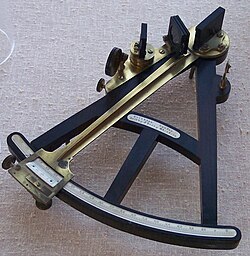
Newton's Innovative Design of the Octant
Science
Instruments
3 min read
Updated By: History Editorial Network (HEN)
Published:
Updated:
Newton's innovative design of the octant, also known as the reflecting quadrant, marked a pivotal advancement in navigational instruments. This design was notable for being the first to incorporate two mirrors, which allowed for simultaneous viewing of both the horizon and celestial bodies. This dual-mirror system significantly enhanced the accuracy of measurements, a critical factor for navigation and astronomy. The ability to obtain stable views of both reference points improved the reliability of readings taken by navigators and astronomers alike. Although Newton's original quadrant was constructed, it did not survive to modern times, limiting direct study of his work. However, the principles behind his design influenced subsequent developments in navigational tools. John Hadley, an inventor who came later, created a similar double reflecting quadrant without knowledge of Newton's earlier invention, demonstrating the impact of Newton's ideas on the field of navigation. The octant became a fundamental instrument in maritime navigation, allowing sailors to determine their latitude by measuring the angle of celestial bodies above the horizon. This innovation played a crucial role in the Age of Exploration, enabling more accurate sea travel and contributing to the expansion of global trade routes.
#mooflife
#MomentOfLife
#Newton
#Octant
#ReflectingQuadrant
#Navigation
#Astronomy

Explore the Life Moments of
 AI Twin