Wilkinson invents cylinder boring machine
Bersham Ironworks, located in the village of Bersham near Wrexham, Wales, United Kingdom
Industrial Revolution
Engineering Innovations
Steam Engine Development
6 min read
Updated By: History Editorial Network (HEN)
Published:
Updated:
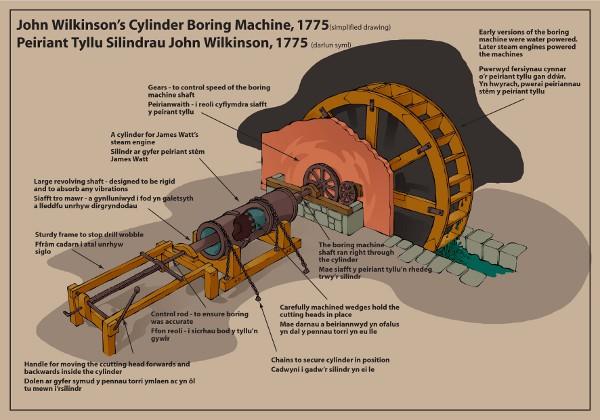
John Wilkinson's invention of the cylinder boring machine marked a pivotal advancement in the manufacturing of steam engines. Prior to this innovation, the process of boring cylinders was labor-intensive and often resulted in imprecise dimensions, which could compromise the efficiency and functionality of steam engines. Wilkinson's machine allowed for the precise boring of cylinders, which was essential for the development of more reliable steam engines. His work directly contributed to the success of the Boulton and Watt steam engine, a significant development in the industrial revolution. After successfully boring the first cylinder for this steam engine, Wilkinson secured an exclusive contract to supply cylinders, establishing him as a key player in the burgeoning steam engine industry. This contract not only solidified his reputation but also enabled him to influence the production standards of steam engines significantly. He obtained British patent No. 1063 patent for "A New Method of Casting and Boring Iron Guns or Cannon".
Key Technical Innovations:
In 1774, the English industrialist John "Iron-Mad" Wilkinson invented a revolutionary cylinder boring machine that became a cornerstone of the Industrial Revolution. Often cited as the first true machine tool, his invention provided the precision necessary to make James Watt’s steam engine a commercial reality. Prior to Wilkinson's invention, cylinders were bored using cantilevered cutters that frequently wobbled, resulting in "out-of-round" bores that leaked steam. Wilkinson's machine introduced:
- The Hollow Boring Bar: A rigid, hollow iron shaft that passed entirely through the cylinder.
- Dual Support: Unlike previous designs, the bar was supported at both ends, ensuring the cutting head remained perfectly centered and stable.
- Line-Boring Principle: This established the modern principle of line-boring, allowing for unprecedented accuracy in large-scale metal machining.
Impact on the Steam Engine:
Before 1774, James Watt struggled to find cylinders precise enough to maintain a vacuum; steam would simply leak past the poorly fitted pistons.
- The Breakthrough: Wilkinson's machine could bore a 50-inch cylinder with a tolerance no greater than "the thickness of an old shilling".
- The Partnership: This precision enabled Boulton & Watt to build their first commercial engines. Wilkinson was subsequently awarded an exclusive contract to supply all their cylinders.
Origin in Military Technology:
The machine was an adaptation of Wilkinson's 1774 patent for boring iron cannons from solid castings. Instead of casting a hollow core (which often had internal defects), Wilkinson rotated the entire cannon barrel against a fixed boring bar, creating straighter, more reliable guns that were less likely to explode.
#mooflife
#MomentOfLife
#Wilkinson
#CylinderBoringMachine
#SteamEngine
#IndustrialRevolution
#BoultonAndWatt

Explore the Life Moments of
 AI Twin