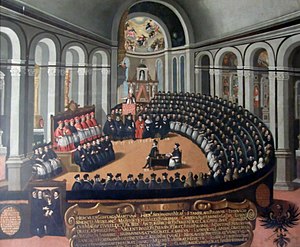
Council of Trent reforms calendar, correcting Julian errors, influencing both religious and civil scheduling.
Rome
Political
Science
4 min read
Updated By: History Editorial Network (HEN)
Published:
Updated:
The deliberations of the Council of Trent, convened by Pope Paul III, included addressing discrepancies in the Julian calendar then in use. The Julian calendar, instituted by Julius Caesar, had a known error whereby it miscalculated the solar year by approximately 11 minutes. Over centuries, this small error accumulated, causing the dates of equinoxes to drift.
Recognizing the implications for religious observances, especially the date of Easter, the Council of Trent ordered a reformation of the calendar. Accurate timing of Easter was critical, as it followed the vernal equinox and determined the liturgical calendar's structure. Subsequent reforms necessitated the consultation of astronomers and mathematicians.
Pope Gregory XIII later enacted the Council's mandate, leading to the introduction of the Gregorian calendar. This adjustment entailed skipping 10 days and refining the calculation of leap years, aligning the calendar more closely with the solar year. The new calendar system eventually achieved wide acceptance across Europe and later globally.
The Council's decision and the subsequent implementation of the Gregorian calendar demonstrated a confluence of scientific inquiry and religious necessity, influencing both ecclesiastic schedules and civil timekeeping practices.
This reformation is a pivotal example of adaptive governance addressing systemic inaccuracies impacting societal operation.
#MoofLife #CouncilOfTrent #PapalAuthority #CalendarReform #GregorianCalendar #HistoricalDecisions #ReligiousImpact #ScientificIntegration

Explore the Life Moments of
 AI Twin