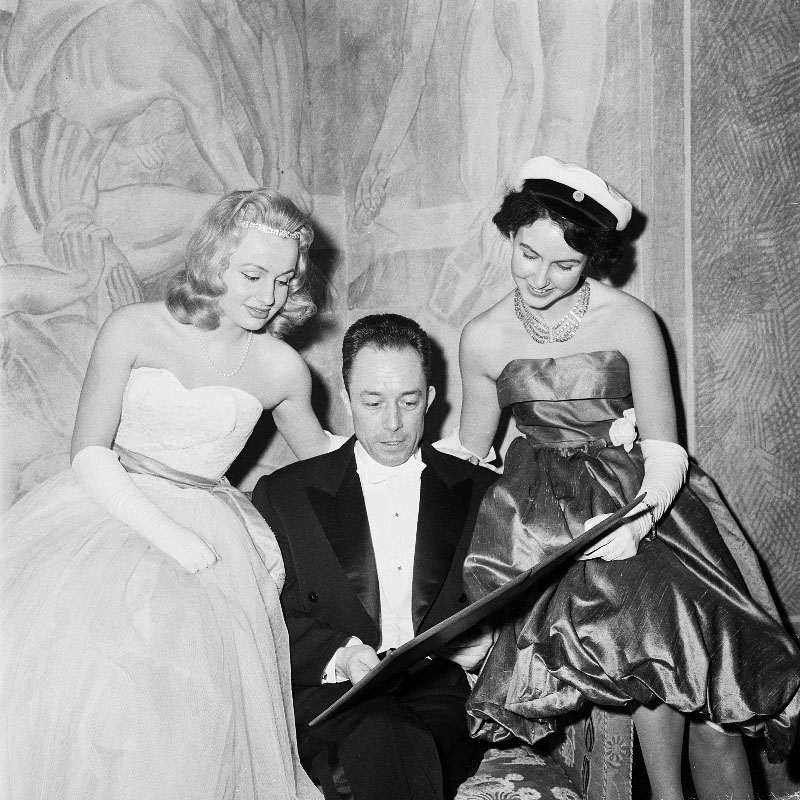
Albert Camus awarded the Nobel Prize in Literature.
France

Literature
8 min read
Updated By: History Editorial Network (HEN)
Published:
On October 17, 1957, Albert Camus was awarded the Nobel Prize in Literature, recognizing his significant contributions to French and global literature. Camus, a French-Algerian philosopher, author, and journalist, was honored for his body of work that illuminated the human condition, explored themes of existentialism and absurdism, and delved into the moral and political complexities of the 20th century.
Background
Albert Camus was born on November 7, 1913, in Mondovi, French Algeria. His early life was marked by poverty and the challenges of growing up in a colonial society. Despite these hardships, Camus excelled academically and pursued studies in philosophy at the University of Algiers. His experiences in Algeria profoundly influenced his worldview and literary themes, particularly the tension between colonial power and indigenous identity.
Literary Contributions
Camus's literary career began in earnest with his involvement in theater and journalism. His first significant publication, The Stranger (1942), introduced the world to his unique narrative style and philosophical outlook. The novel tells the story of Meursault, a detached and emotionally indifferent protagonist, whose senseless murder of an Arab man and subsequent trial highlight the absurdity and arbitrariness of life. The Stranger became a seminal work in existential literature.
In 1942, Camus also published The Myth of Sisyphus, a philosophical essay that articulates his concept of the absurd—the conflict between humans' desire for meaning and the silent, indifferent universe. He uses the Greek myth of Sisyphus, condemned to eternally push a boulder up a hill only for it to roll back down, as a metaphor for human existence. Camus argues that one must imagine Sisyphus happy, finding meaning in the struggle itself.
Camus's subsequent works, including The Plague (1947) and The Fall (1956), further established his literary and philosophical reputation. The Plague, set in the Algerian city of Oran, is an allegory of the human condition and a reflection on suffering, solidarity, and resistance. The Fall delves into themes of guilt, redemption, and the complexity of human morality through the confessions of a disillusioned Parisian lawyer in Amsterdam.
Nobel Prize Award
The Nobel Committee awarded Camus the Nobel Prize in Literature in 1957 for his "important literary production, which with clear-sighted earnestness illuminates the problems of the human conscience in our time." At 44, he was one of the youngest recipients of the prize. The award recognized not only his literary achievements but also his commitment to addressing profound ethical and philosophical questions through his writing.
Impact and Legacy
Camus's receipt of the Nobel Prize solidified his status as a leading intellectual and literary figure of his time. His works have been translated into numerous languages and continue to be studied and celebrated worldwide. Camus's exploration of the absurd, his emphasis on human dignity, and his moral and political engagement have left an enduring legacy in both literature and philosophy.
Beyond his literary contributions, Camus was also known for his activism and outspoken views on social and political issues. He was a vocal critic of totalitarianism in all forms and advocated for human rights and justice. His stance on the Algerian War of Independence, advocating for a peaceful resolution and reconciliation between French and Algerians, highlighted his commitment to nuanced and humane solutions to complex conflicts.
#MomentsOfLife #MoofLife_Moment #MoofLife #AlbertCamus #NobelPrize #Literature #Existentialism #Absurdism #FrenchLiterature #1957 #HumanCondition #Philosophy #CulturalLegacy
Primary Reference
The Nobel Prize in Literature 1957

Explore the Life Moments of
 AI Twin