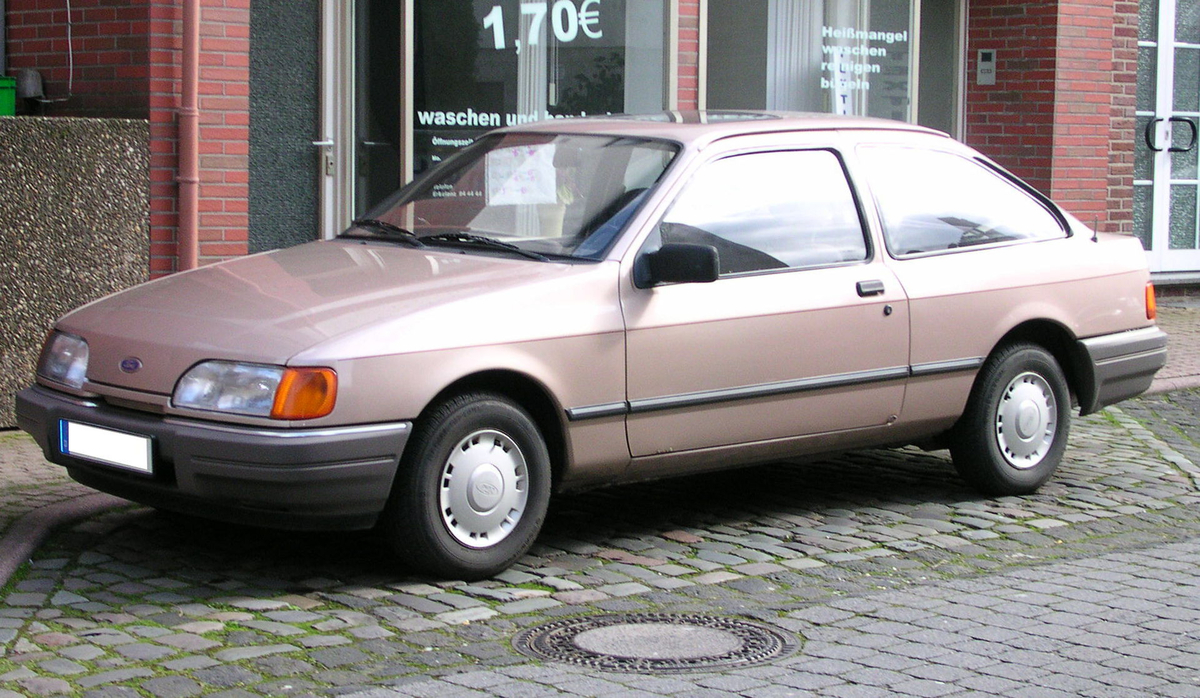
Ford Sierra's Controversial Launch and Design
National Exhibition Centre, Birmingham, England, United Kingdom
Automotive
Ford
8 min read
Updated By: History Editorial Network (HEN)
Published:
Updated:
On 22/09/1982, Ford Motor Company officially unveiled the Ford Sierra at the British International Motor Show in Birmingham, introducing one of the most distinctive and debated family cars of its era. Developed under the internal code name "Project Toni" at an estimated cost of approximately US$1.2 billion, the Sierra was created to replace the long-running Ford Cortina in the United Kingdom and the Ford Taunus across mainland Europe. The launch marked a bold departure from the styling conventions that had defined Ford's most successful European models for nearly two decades.
The Sierra was tasked with succeeding the Cortina, a vehicle that had become one of Britain's best-selling cars since its introduction in 1962. By the early 1980s, however, Ford recognized that increasing competition, fuel economy concerns, and advances in automotive engineering required a new approach. Rather than producing a traditional three-box sedan similar to its predecessor, Ford's designers and engineers pursued a highly aerodynamic shape intended to improve efficiency and modernize the company's image.
The result was a vehicle whose rounded profile contrasted sharply with the angular family cars common at the time. Influenced by aerodynamic research and concepts developed during the 1970s, the Sierra achieved a drag coefficient significantly lower than many competing vehicles. Ford promoted the design under the slogan "Man and Machine in Perfect Harmony", emphasizing both technology and efficiency. The vehicle's smooth contours, sloping nose, integrated bumpers, and hatchback body style represented a substantial shift from the conservative appearance of the Cortina.
Public reaction was immediate and often divided. While many observers praised Ford's willingness to introduce a modern aerodynamic design, others viewed the styling as too radical for mainstream family-car buyers. British media outlets frequently described the vehicle as futuristic, and some critics questioned whether traditional Cortina customers would accept such a dramatic change. The controversy surrounding the design became one of the defining aspects of the Sierra's launch and generated considerable publicity across Europe.
Despite the initial skepticism, the Sierra gradually gained acceptance in the marketplace. Ford expanded the range with additional body styles, trim levels, and performance variants, including the high-performance Sierra XR4i and later the Sierra RS Cosworth, which became one of the most celebrated sports sedans of the 1980s. The model ultimately achieved strong sales across Europe and remained in production until 1993, when it was succeeded by the Ford Mondeo.
The Sierra's development represented one of the largest investments in Ford of Europe's history at the time. The project reflected the company's determination to maintain its leadership position in the highly competitive European family-car segment while demonstrating the commercial viability of aerodynamic design principles that would later influence vehicle development throughout the industry.
Why This Moment Matters:
The unveiling of the Ford Sierra marked a significant change in European automotive design. By replacing the conservative Cortina with a highly aerodynamic and unconventional successor, Ford challenged prevailing industry trends and helped accelerate the adoption of streamlined vehicle styling. Although controversial at launch, the Sierra went on to become one of the defining European cars of the 1980s and a notable chapter in Ford's product history.
#mooflife
#MomentOfLife
#FordSierra
#AutomotiveDesign
#AerodynamicStyling
#FordHistory
#CarManufacturing
Primary Reference
Ford Motor Company

Explore the Life Moments of
 AI Twin