First Moving Assembly Line Introduced
Highland Park, Michigan, United States
Automotive Industry
Manufacturing Innovation
Historical Developments
6 min read
Updated By: History Editorial Network (HEN)
Published:
Updated:
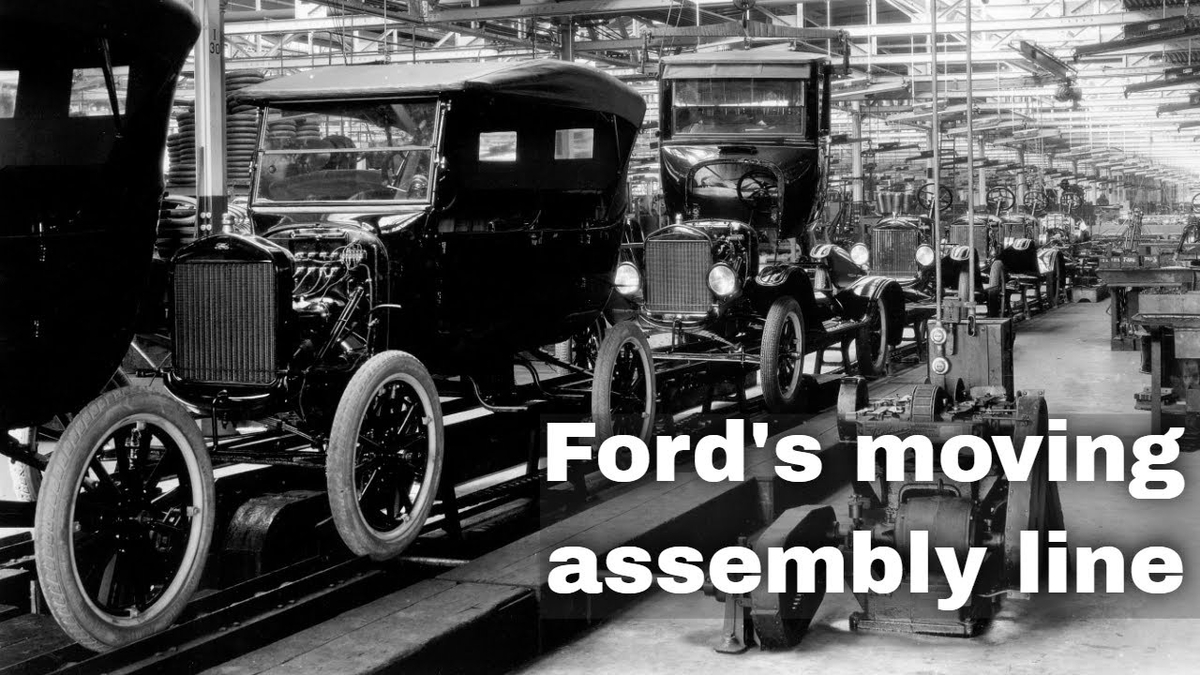
On 07/10/1913, the Ford Motor Company implemented one of the most influential manufacturing innovations of the twentieth century at its Highland Park plant in Michigan. The company introduced a rudimentary moving assembly line for the Model T chassis, bringing together major vehicle components in a continuous production process. Rather than having workers move between stationary vehicles, the chassis was moved through a sequence of workstations, with employees performing specialized tasks at each stage of assembly.
The development was the result of years of experimentation by Ford engineers and production managers seeking ways to increase efficiency and reduce manufacturing costs. Drawing inspiration from methods used in industries such as meatpacking, grain handling, and industrial processing, Ford adapted the concept of continuous flow production to automobile manufacturing. The first moving chassis line was relatively simple, using a rope-and-winch system to pull the Model T chassis along the factory floor while workers completed designated assembly operations.
The immediate effect was a substantial reduction in the time required to assemble a vehicle. Prior to the moving assembly line, assembling a Model T chassis required many hours of labor. As Ford refined the process and expanded assembly line techniques throughout the Highland Park facility, production times decreased dramatically. The improvements enabled the company to increase output, lower manufacturing costs, and gradually reduce the selling price of the Model T, making automobile ownership accessible to a larger segment of the population.
The moving assembly line became a defining feature of modern industrial production. Manufacturers around the world studied and adopted similar methods in industries ranging from automotive manufacturing to consumer goods, electronics, and heavy industry. Ford's system demonstrated how standardized parts, specialized labor, and continuous workflow could be combined to achieve large-scale production with unprecedented efficiency.
Why This Moment Matters:
The introduction of the moving assembly line at Highland Park represented more than a change in automobile production. It provided a practical model for mass manufacturing that influenced factories across numerous industries and countries. The principles demonstrated on Ford's Model T assembly line continued to shape industrial production methods throughout the twentieth century and remain visible in modern manufacturing systems today.
#mooflife
#MomentOfLife
#AssemblyLine
#FordMotorCompany
#ManufacturingInnovation
#AutomobileIndustry
#MassProduction
Primary Reference
Moving assembly line debuts at Ford factory

Explore the Life Moments of
 AI Twin