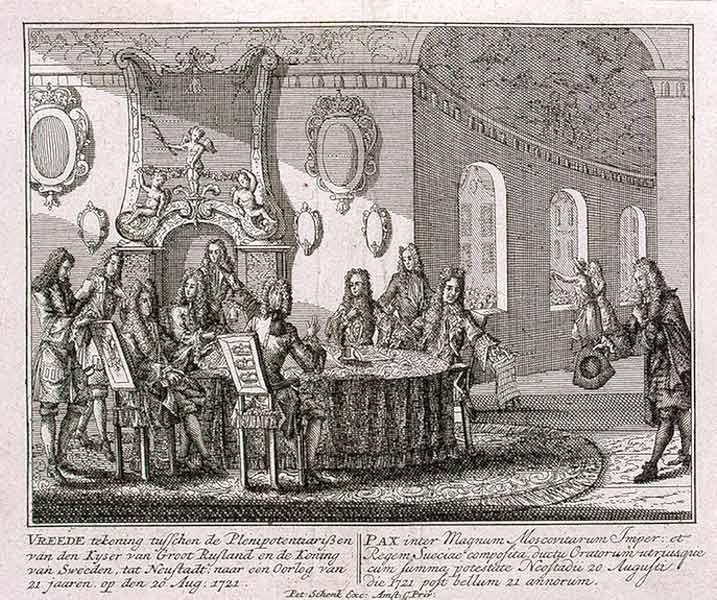
Treaty of Nystad Signing.
Finland

Political
European
3 min read
Updated By: History Editorial Network (HEN)
Published:
The Treaty of Nystad marked the end of the Great Northern War between Russia and Sweden. After years of conflict, the treaty was signed in Nystad, a town in present-day Finland. The war had begun in 1700, fueled by territorial ambitions and power struggles in the region. Sweden, under King Charles XII, had initially been a dominant force, but after a series of defeats, including the devastating Battle of Poltava in 1709, the tide turned in favor of Russia.
The treaty formalized Russia's emergence as a major power in the region, with Sweden ceding significant territories, including parts of modern-day Finland, Estonia, and Livonia. The treaty reshaped the geopolitical landscape of Northern Europe, consolidating Russia's influence while diminishing Sweden's dominance.
The signing of the Treaty of Nystad had lasting effects on the region. Finland, previously a part of the Swedish Empire, now became a vital part of the Russian Empire. The treaty also established new borders and diplomatic relationships that would define Northern Europe for years to come.
The Treaty of Nystad is remembered as a key moment in Finnish and European history, symbolizing the shift in power dynamics in the region. It marked the end of an era of Swedish dominance and the beginning of Russian ascendency. The treaty's legacy can still be seen in the modern borders and relationships of the countries involved.
#TreatyofNystad #GreatNorthernWar #Geopolitics #Russia #Sweden #Finland #EuropeanHistory
Primary Reference
Treaty of Nystad - Wikipedia
Explore the Life Moments of
 AI Twin