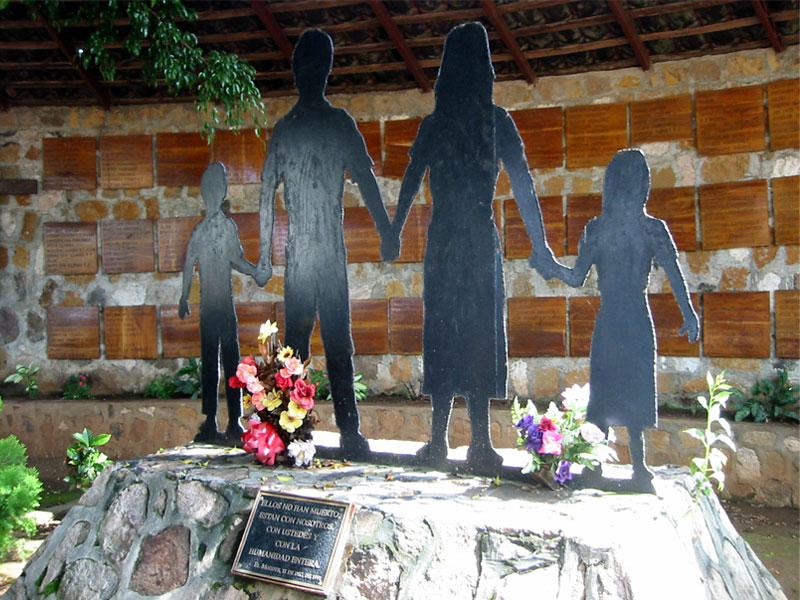
Massacre of hundreds of civilians by government forces at EL Mozote.
El Salvador

10 min read
Updated By: History Editorial Network (HEN)
Published:
The El Mozote massacre, which took place on December 11, 1981, in the small village of El Mozote in El Salvador, stands as one of the most horrific atrocities of the Salvadoran Civil War (1980-1992). On this day, government forces systematically killed hundreds of civilians, including men, women, and children, in a brutal operation that sought to eradicate guerrilla sympathizers. The massacre, which was denied and covered up by the Salvadoran government and its allies for years, eventually came to symbolize the extreme violence and human rights abuses that characterized the conflict.
The Salvadoran Civil War: A Context of Violence
The Salvadoran Civil War was a bitter and protracted conflict between the U.S.-backed Salvadoran government and leftist guerrilla groups led by the Farabundo Martí National Liberation Front (FMLN). The war emerged from deep-rooted social, economic, and political inequalities in El Salvador, with the FMLN fighting for radical reforms and the government seeking to maintain the status quo.
The Salvadoran government, supported by significant military aid from the United States, pursued a counterinsurgency strategy that often targeted not only guerrilla fighters but also civilians suspected of sympathizing with the rebels. This strategy led to widespread human rights abuses, including extrajudicial killings, disappearances, and massacres, with the El Mozote massacre being one of the most egregious examples.
The Massacre at El Mozote
In early December 1981, the Atlacatl Battalion, an elite unit of the Salvadoran army trained by U.S. military advisors, was deployed to the Morazán department in northeastern El Salvador. Their mission was to eliminate guerrilla forces operating in the area. On December 10, the battalion reached the village of El Mozote, where they suspected the presence of FMLN supporters.
The villagers, who were mostly poor farmers, had been assured by the army that they would not be harmed if they cooperated. As a result, many residents, along with people from neighboring communities who had sought refuge in El Mozote, stayed in the village. However, the promises of safety were a deception.
On the morning of December 11, the soldiers began their assault. They first separated the men from the women and children. The men were taken to a nearby field, where they were tortured and executed. The soldiers then turned their attention to the women and children, who were forced into the village's church and several other buildings. Over the course of the day, the women were systematically raped before being killed. The children were not spared; many were brutally murdered, some with machetes, others by gunfire. By the end of the massacre, nearly the entire population of El Mozote, estimated to be between 800 and 1,200 people, had been exterminated.
After the killings, the soldiers set fire to the buildings and bodies, leaving the village in ruins. Survivors of the massacre were scarce, with only a few individuals managing to escape the carnage and live to tell the tale.
Denial and Cover-Up
In the immediate aftermath, the Salvadoran government and military vehemently denied that a massacre had occurred. When reports of the killings began to surface, they were dismissed as guerrilla propaganda. Despite accounts from survivors and initial reports by journalists, including Raymond Bonner of The New York Times and Alma Guillermoprieto of The Washington Post, the massacre remained largely unacknowledged, with U.S. officials downplaying the event to maintain support for the Salvadoran government.
For years, the official narrative was one of denial, and the victims of El Mozote were left without justice or recognition. The massacre became emblematic of the broader pattern of impunity and the suppression of truth during the Salvadoran Civil War.
Uncovering the Truth
It wasn't until the end of the war and the signing of the Chapultepec Peace Accords in 1992 that a more thorough investigation into the massacre became possible. In the early 1990s, forensic teams began exhuming bodies from mass graves in El Mozote, uncovering the remains of hundreds of victims, including many children, confirming the horrific accounts of the massacre.
In 1993, the United Nations-sponsored Truth Commission for El Salvador documented the El Mozote massacre as one of the most significant human rights violations of the war. The commission concluded that the Salvadoran army had indeed carried out the massacre, and it highlighted the complicity of those who had covered up the atrocity.
Despite these findings, efforts to hold those responsible accountable were hampered by a 1993 amnesty law that protected perpetrators of wartime crimes. It wasn't until this law was overturned in 2016 that new legal proceedings against former military officers involved in the massacre were initiated, offering a glimmer of hope for justice.
Legacy and Remembrance
The El Mozote massacre remains a painful memory in El Salvador, a symbol of the extreme violence and suffering inflicted upon innocent civilians during the civil war. The village of El Mozote has since become a place of pilgrimage and remembrance, with memorials erected to honor the victims.
The massacre has also served as a stark reminder of the dangers of impunity and the importance of truth and justice in post-conflict societies. As El Salvador continues to grapple with its past, the legacy of El Mozote endures as a testament to the resilience of the survivors and the enduring quest for justice.
#MomentsOfLife #MoofLife_Moment #MoofLife #ElMozoteMassacre #HumanRights #ElSalvador #CivilWar #JusticeForVictims
Explore the Life Moments of
 AI Twin