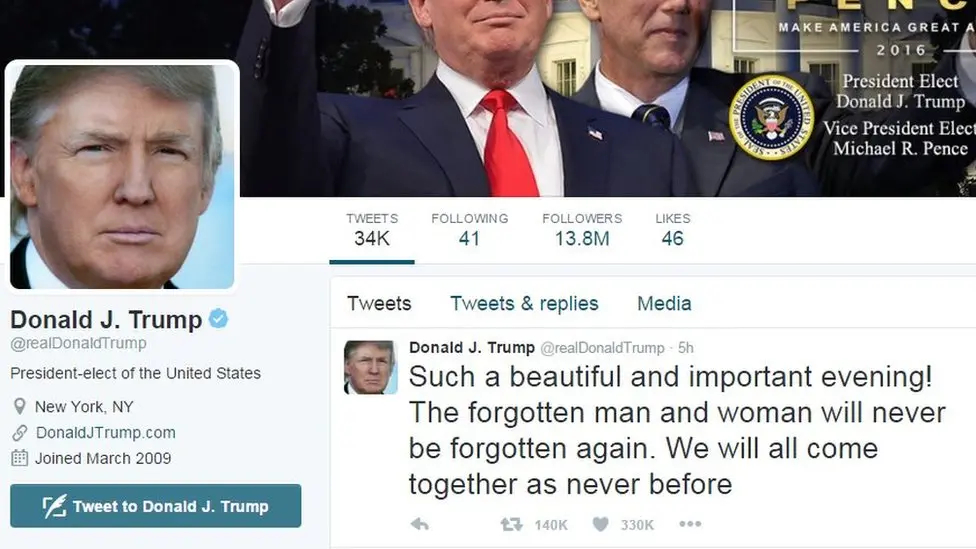
Elected as the 45th President of the United States

Political
10 min read
Updated By: History Editorial Network (HEN)
Published:
Updated:
On November 8, 2016, Donald Trump was elected as the 45th President of the United States, in one of the most surprising and consequential political upsets in American history. Running as the Republican nominee, Trump defeated the Democratic nominee, former Secretary of State Hillary Clinton, despite trailing in most national polls leading up to the election. His victory not only defied widespread expectations but also signaled a dramatic shift in the U.S. political landscape, reflecting deep divisions within the electorate.
The Path to the Presidency
Trump's path to the presidency began with his announcement on June 16, 2015, when he descended the escalator in Trump Tower and declared his candidacy. From the start, his campaign was marked by controversial statements, an unorthodox approach, and a populist message that resonated with many voters who felt disillusioned by the political establishment.
Throughout the Republican primaries, Trump steadily gained momentum, defeating a large field of seasoned politicians, including Jeb Bush, Ted Cruz, and Marco Rubio. His success in the primaries was driven by his appeal to voters who were frustrated with the status quo, particularly on issues like immigration, trade, and national security. By May 2016, Trump had secured the Republican nomination, setting the stage for a contentious general election against Hillary Clinton.
The General Election Campaign
The 2016 general election campaign was one of the most bitter and polarizing in modern U.S. history. Trump’s campaign was characterized by its focus on nationalism, anti-immigration rhetoric, and promises to "Make America Great Again." He positioned himself as an outsider capable of shaking up Washington, D.C., and appealed to voters who felt left behind by globalization and economic change.
Hillary Clinton, widely seen as the frontrunner and backed by much of the political establishment, ran a campaign centered on her experience and the continuation of President Barack Obama's policies. However, she faced significant challenges, including controversies over her use of a private email server as Secretary of State, ongoing investigations, and questions about her trustworthiness.
Trump, meanwhile, faced numerous controversies of his own, including accusations of sexual misconduct, divisive rhetoric, and a leaked recording in which he made vulgar comments about women. Despite these issues, Trump maintained a strong base of support, particularly among white working-class voters, evangelicals, and those disillusioned with the political elite.
Election Night and the Results
On election night, November 8, 2016, the nation and the world watched as results came in from across the United States. While many analysts and polls had predicted a Clinton victory, the results told a different story. Trump won key battleground states, including Florida, Ohio, Pennsylvania, Michigan, and Wisconsin, all of which had been expected to lean towards Clinton.
In a stunning upset, Trump secured 304 electoral votes to Clinton's 227, winning the presidency despite losing the popular vote by nearly 3 million votes. His victories in traditionally Democratic states in the Rust Belt, where economic anxiety and frustration with globalization were prevalent, were critical to his electoral success.
Reaction and Aftermath
Trump's victory shocked the political establishment, media, and much of the global community. For many, it was a clear rejection of the status quo and a sign of deep divisions within the country. The election exposed significant rifts in American society, including urban-rural divides, racial tensions, and economic disparities.
Supporters of Trump celebrated his victory as a triumph for "real America" and a repudiation of political correctness and establishment politics. They saw in Trump a leader who could bring jobs back to the U.S., secure the borders, and restore America's standing in the world.
On the other hand, Trump's election prompted widespread protests and concerns about the direction of the country. His divisive campaign and rhetoric raised fears about the future of civil rights, immigration policies, and America's role on the global stage.
The Impact of Trump’s Election
Trump's election marked a significant moment in U.S. history, ushering in a presidency that would be as controversial as his campaign. His tenure in the White House was characterized by significant policy shifts, a combative relationship with the media, and an often unorthodox approach to governance.
Domestically, Trump pursued policies that reflected his campaign promises, including tax cuts, deregulation, and a hardline stance on immigration. His administration also saw significant judicial appointments, including three Supreme Court justices, which have had a lasting impact on American law and society.
Internationally, Trump’s "America First" foreign policy led to a realignment of U.S. relationships with allies and adversaries alike, with a focus on renegotiating trade deals and reducing U.S. involvement in multilateral agreements.
Trump’s presidency deeply polarized the American electorate, with his supporters remaining fiercely loyal while his opponents mobilized in resistance. His term culminated in a tumultuous 2020 election and its aftermath, which continued to influence U.S. politics long after he left office.
#MomentsOfLife #MoofLife_Moment #MoofLife #DonaldTrump #2016Election #AmericanPolitics #PresidentialElection #PoliticalHistory
#2016Election
Primary Reference
Donald J. Trump – The White House

Explore the Life Moments of
 AI Twin