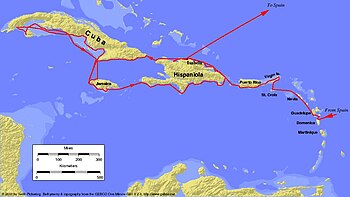
Christopher Columbus Visits the Island and Names it Dominica (Sunday Island)
Dominica
Global Trade
3 min read
Updated By: History Editorial Network (HEN)
Published:
Updated:
On a Sunday, during his second voyage to the Americas, Christopher Columbus sighted an unknown island in the Caribbean Sea. Upon approaching the land, he decided to name it Dominica, drawing from the Latin word for Sunday, "dies Dominica," reflecting the day he first encountered the island.
This discovery represented a continuation of European exploration in the New World, a period marked by navigational expertise and the expansion of Spanish territorial claims. Dominica emerged as an important geographical point within the greater landscape of the Caribbean, which was becoming increasingly significant for European powers both for its strategic location and its potential resources.
Columbus's sighting of Dominica led to subsequent European interest in the island, influencing its future settlement and development. The native Kalinago people, initially inhabitants of the island, faced the impacts of colonization and the resultant socio-cultural changes brought by European settlers. The event echoed broader themes of exploration, colonization, and cross-cultural encounters that characterized the Age of Discovery.
#ChristopherColumbus #Dominica #LatinWord #Sunday #AgeofDiscovery #EuropeanExploration #CaribbeanHistory #KalinagoPeople #MoofLife
Primary Reference
Commonwealth of Dominica
Explore the Life Moments of
 AI Twin