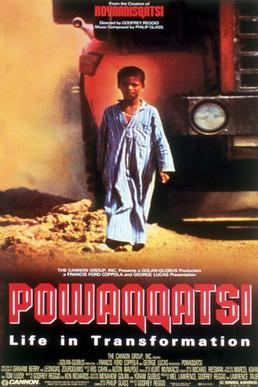
Powaqqatsi
5 min read
Updated By: History Editorial Network (HEN)
Published:
Powaqqatsi is a 1988 experimental documentary directed by Godfrey Reggio and scored by Philip Glass, serving as the second film in the Qatsi Trilogy, following Koyaanisqatsi (1982). While Koyaanisqatsi examined the industrialized world’s impact on nature, Powaqqatsi shifts focus to the developing world—specifically the tension between traditional ways of life and the encroaching force of globalization and modernization. The title comes from the Hopi language and loosely translates to “life in transformation” or “a parasitic way of life.”
The film unfolds without dialogue or narration. Instead, it presents a series of meticulously composed visual sequences shot across countries in Asia, Africa, South America, and the Middle East. The imagery focuses on people—miners, laborers, children, farmers—engaged in physical work, rituals, and daily survival. Scenes of bustling markets, construction sites, religious processions, and environmental degradation are edited rhythmically to Glass’s evolving, percussion-heavy score, which blends global instrumentation with minimalist composition.
Visually, Powaqqatsi trades the sterile, mechanical precision of Koyaanisqatsi for a more colorful and organic palette. It uses slow motion and time-lapse techniques but places greater emphasis on human subjects rather than architecture or machinery. The effect is hypnotic, sometimes beautiful, sometimes overwhelming—inviting the viewer to witness the cultural erosion and material disparity brought on by modernity.
The film premiered at the Cannes Film Festival in 1988 and received mixed critical response. Some praised its ambition and visual poetry, while others found it less cohesive or impactful than its predecessor. It had a modest theatrical run and performed modestly at the box office, appealing primarily to fans of experimental or non-narrative cinema.
Despite initial division, Powaqqatsi has grown in stature over time as part of the Qatsi Trilogy. Its legacy lies in its attempt to humanize global transformation through a sensory experience rather than a political argument. It doesn’t tell viewers what to think—it shows them what’s at stake in a world being rapidly reshaped by power, technology, and economic imbalance.

Explore the Life Moments of
 AI Twin