Lessons of Darkness
5 min read
Updated By: History Editorial Network (HEN)
Published:
Lessons of Darkness is a 1992 documentary directed by Werner Herzog, filmed in the aftermath of the Gulf War. Shot primarily in Kuwait, the film captures the haunting devastation left behind by the retreating Iraqi army, particularly the burning oil fields, destroyed infrastructure, and scorched earth. Unlike conventional war documentaries, Herzog’s approach is not journalistic or political—instead, he crafts the film as an abstract, almost alien meditation on destruction, using apocalyptic imagery and a sparse narrative to frame the war as a surreal, mythic tragedy.
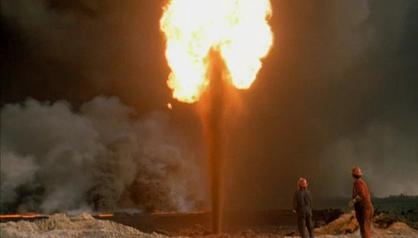
There is no traditional plot or exposition. The film is divided into short chapters, each introduced with cryptic text, and narrated by Herzog in a deliberately detached, philosophical tone. Footage of smoke-choked skies, oil fires spewing flames into the desert, and workers dwarfed by the infernos is paired with orchestral music, including compositions by Wagner, Mahler, and Verdi. The camera often soars overhead, treating the earth like a dying planet seen from afar, emphasizing the scale of ruin and the human helplessness against it.
Visually, the film is stunning and terrifying. Cinematographer Paul Berriff captures the burning oil fields in high-contrast beauty—black skies, orange flames, and ghostly silhouettes of machines and people moving through toxic wastelands. Herzog adds no interviews, no direct references to the Gulf War, and no attempt to contextualize the events politically. Instead, he presents the aftermath as a cautionary tale of mankind’s capacity for self-destruction.
The film premiered at the Berlin International Film Festival and received acclaim for its artistic vision and unorthodox structure. While too abstract for mainstream audiences, it was celebrated in academic, film, and art circles. It had a limited theatrical release and gained wider exposure through retrospectives and film study programs.
Lessons of Darkness stands as one of Herzog’s most visually powerful and philosophically charged works. It transforms documentary into allegory, framing modern warfare not through facts and statistics, but through haunting imagery that suggests the end of civilization witnessed by a distant observer. It is a film less about war than about the ruin it leaves behind—and the silence that follows.

Explore the Life Moments of
 AI Twin