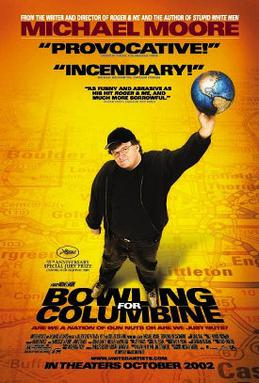
Bowling for Columbine
5 min read
Updated By: History Editorial Network (HEN)
Published:
Bowling for Columbine is a 2002 documentary directed by Michael Moore that investigates America’s culture of gun violence, using the 1999 Columbine High School massacre as its launching point. The film is not a forensic breakdown of the shooting itself, but a broader examination of why the United States has vastly higher rates of gun deaths compared to other developed nations. Through satire, interviews, media clips, and confrontational ambush journalism, Moore crafts a politically charged narrative about fear, racism, militarism, and corporate influence.
Moore interviews a wide spectrum of voices—from Columbine survivors to members of the Michigan Militia, from victims of gun-related tragedies to public figures like Charlton Heston, then-president of the National Rifle Association. In a controversial moment, Moore confronts Heston at his home with a photo of a shooting victim, pressing him about the NRA's decision to hold rallies soon after mass shootings. The film also includes animated segments (notably the darkly comedic "A Brief History of the United States") and edited montages set to music, using irony and juxtaposition to criticize media fear-mongering and systemic inequality.
Stylistically, the documentary is fast-paced, provocative, and deliberately manipulative—Moore leans heavily on montage, sarcasm, and confrontation to drive his points. While not neutral or balanced by design, the film is crafted to agitate, provoke, and compel viewers to reconsider assumptions about gun culture, the Second Amendment, and American exceptionalism.
Bowling for Columbine premiered at the Cannes Film Festival, where it won the 55th Anniversary Prize, and went on to win the Academy Award for Best Documentary Feature in 2003. It grossed over $58 million worldwide, making it one of the most commercially successful documentaries of all time at the time of its release. It also won the César Award for Best Foreign Film, a rare honor for a documentary.
The film was both celebrated and criticized—praised for spotlighting a pressing national crisis and condemned for its tactics and perceived bias. Regardless of stance, its impact was undeniable. Bowling for Columbine remains one of the most influential political documentaries of the 21st century, credited with reigniting public discourse on gun violence in America.

Explore the Life Moments of
 AI Twin