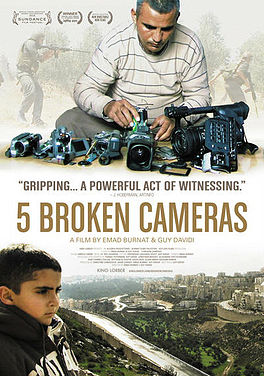
5 Broken Cameras
5 min read
Updated By: History Editorial Network (HEN)
Published:
5 Broken Cameras is a 2011 documentary co-directed by Palestinian farmer Emad Burnat and Israeli filmmaker Guy Davidi. Shot over several years in the West Bank village of Bil’in, the film documents the nonviolent resistance movement against the Israeli separation barrier encroaching on Palestinian farmland. The story is told entirely through Burnat’s perspective, using footage captured on five different camcorders—each one destroyed during the course of filming, either by military action or protest violence, hence the film’s title.
The documentary unfolds as a personal diary, beginning with the birth of Burnat’s son Gibreel and evolving into a chronicle of protest, arrest, injury, and loss. As the barrier cuts through Bil’in’s land, the villagers begin weekly demonstrations, joined by Israeli and international activists. The camera captures escalating clashes, tear gas, night raids, and shootings. Alongside the broader political context, Burnat shares intimate moments of daily life, family tension, and his own emotional struggle with the violence unfolding around him.
Visually, the film is rough and direct, prioritizing presence over polish. The damage to the cameras becomes symbolic—not just of broken equipment, but of broken lives and fractured hopes. The editing weaves together protest footage, home video, and narration, crafting a film that’s both deeply personal and politically potent.
5 Broken Cameras premiered at the 2011 International Documentary Film Festival Amsterdam and later screened at Sundance, where it won the World Cinema Directing Award. It was nominated for Best Documentary Feature at the 85th Academy Awards and won an Emmy for Outstanding Informational Programming. Despite being made on a low budget, the film achieved global recognition, praised for its raw honesty, emotional power, and unique collaborative production between a Palestinian and an Israeli.
The documentary has since been used widely in education, human rights advocacy, and political discourse. It stands as one of the most impactful visual records of life under occupation, resistance through documentation, and the toll exacted on ordinary families caught in systemic conflict.

Explore the Life Moments of
 AI Twin