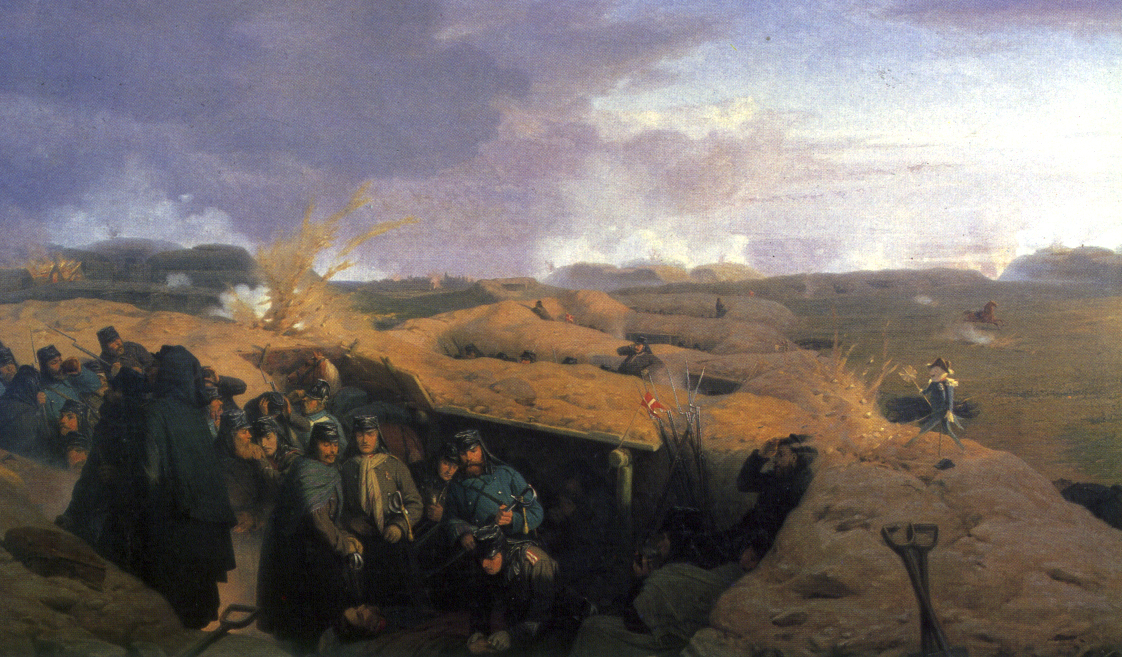
Defeat at Battle of Dybbøl: Second Schleswig War exhibit.
Denmark
Political
4 min read
Updated By: History Editorial Network (HEN)
Published:
During the Battle of Dybbøl, Danish forces faced a decisive defeat against the Prussian and Austrian armies in the Second Schleswig War. The war was fueled by a longstanding territorial dispute over the duchies of Schleswig and Holstein. The Danish government's decision to annex Schlwesig in 1863 as part of the Danish nationalistic movement sparked tensions with the German Confederation.
The Prussian and Austrian forces quickly mobilized against Denmark, gaining the upper hand with their superior numbers and more advanced weaponry. The Danish defenders at Dybbøl put up a valiant effort, but they were ultimately overwhelmed by the enemy's relentless assault. The battle lasted for several days, with heavy casualties on both sides, but the outcome was inevitable.
The defeat at Dybbøl was a turning point in the war, leading to the eventual surrender of the Danish army and the signing of the Treaty of Vienna in which Denmark ceded control of Schleswig, Holstein, and Lauenburg to Prussia and Austria. The loss of these territories had a significant impact on the Danish national identity and marked the beginning of a period of Danish territorial and political decline.
The Battle of Dybbøl remains a symbol of Danish resilience and courage in the face of overwhelming odds. The war itself highlighted the complexities of national identity and territorial disputes in 19th-century Europe. The legacy of the conflict continues to shape Danish-German relations and remains a key chapter in Danish history.
#BattleofDybbøl #SecondSchleswigWar #DanishHistory #TerritorialDispute #EuropeanWarfare

Explore the Life Moments of
 AI Twin