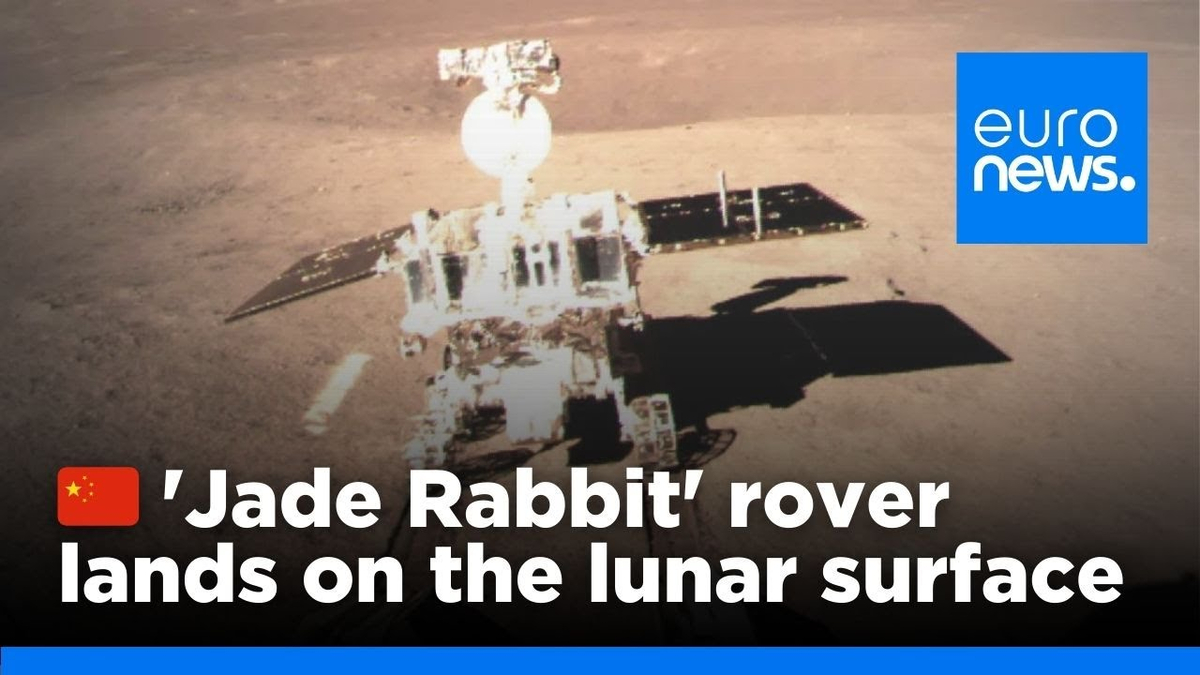
China successfully lands the Yutu ("Jade Rabbit") robotic rover on the surface of the moon, the first soft landing there for 37 years.
China

10 min read
Updated By: History Editorial Network (HEN)
Published:
On December 14, 2013, China achieved a significant milestone in space exploration with the successful landing of the Yutu ("Jade Rabbit") robotic rover on the surface of the Moon. This event marked the first soft landing on the Moon in 37 years, since the Soviet Union's Luna 24 mission in 1976, and underscored China's growing capabilities and ambitions in space technology.
Background
China's lunar exploration program, known as the Chang'e program, named after the Chinese moon goddess, began in the early 2000s. The program is divided into several phases: orbiting, landing, and returning samples to Earth. The Chang'e 3 mission, which included the Yutu rover, was part of the second phase of this ambitious program.
The Chang'e 3 mission followed the successes of Chang'e 1 and Chang'e 2, which were orbiters launched in 2007 and 2010, respectively. These missions provided critical data about the lunar surface and helped in planning for the subsequent landing mission.
The Chang'e 3 Mission
Chang'e 3 was launched on December 1, 2013, from the Xichang Satellite Launch Center using a Long March 3B rocket. The spacecraft consisted of a lander and the Yutu rover. The primary goals of the mission were to demonstrate China's ability to perform a soft landing on the Moon and to carry out scientific exploration of the lunar surface.
Key features and objectives of the Chang'e 3 mission included:
Soft Landing: Achieving a soft landing on the lunar surface to demonstrate China's technological capabilities in controlled descent and landing in a low-gravity environment.
Scientific Exploration: Conducting a range of scientific experiments and observations, including studying the lunar geology, soil composition, and surface morphology.
Technology Demonstration: Testing and validating technologies for future lunar missions, including those for potential manned missions and sample return missions.
The Yutu Rover
The Yutu rover, named after the jade rabbit that accompanies the moon goddess in Chinese mythology, was a six-wheeled, solar-powered vehicle equipped with various scientific instruments. These included a ground-penetrating radar to investigate the lunar subsurface, a panoramic camera, and a visible and near-infrared imaging spectrometer to analyze the composition of lunar rocks and soil.
Landing and Operations
On December 14, 2013, the Chang'e 3 lander successfully touched down in the Moon's Mare Imbrium (Sea of Rains), a vast lava plain. This landing site was selected for its relatively smooth terrain and scientific interest. Shortly after landing, the Yutu rover was deployed to begin its exploration.
The successful landing and deployment of Yutu were significant achievements for China's space program. The rover's mission included the following objectives:
Surface Exploration: Traveling across the lunar surface to collect data on the geological and mineralogical composition of the Moon.
Subsurface Analysis: Using ground-penetrating radar to explore the structure of the lunar soil and crust.
Scientific Research: Conducting experiments to enhance understanding of the Moon's history and development.
Achievements and Challenges
The Yutu rover operated on the lunar surface for approximately 31 months, far exceeding its initial three-month mission plan. During its operational period, Yutu made several important discoveries, including detecting evidence of multiple layers of lava flows in the Mare Imbrium, which provided new insights into the Moon's volcanic history.
However, the mission also faced challenges. Yutu encountered mobility issues after a few weeks, limiting its ability to traverse the lunar surface. Despite these difficulties, the rover continued to transmit valuable scientific data back to Earth, contributing significantly to lunar science.
Legacy and Impact
The successful landing of the Chang'e 3 mission and the deployment of the Yutu rover marked a significant milestone for China's space program. It demonstrated China's growing technological prowess and ambition in space exploration, placing it among the leading spacefaring nations.
The mission's success also paved the way for subsequent lunar missions, including Chang'e 4, which achieved the first-ever soft landing on the far side of the Moon in 2019, and Chang'e 5, which successfully returned lunar samples to Earth in 2020.
#MomentsOfLife #MoofLife_Moment #MoofLife #YutuRover #ChangE3 #ChinaSpaceExploration #LunarMission #JadeRabbit #MoonLanding #SpaceExploration #2013

Explore the Life Moments of
 AI Twin