Carl Sagan: Pioneer of Public Science Education and Communication
United States of America
Science
Education
3 min read
Updated By: History Editorial Network (HEN)
Published:
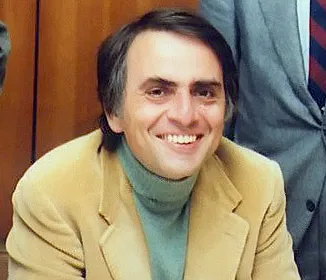
The National Academy of Sciences awarded Carl Sagan the Public Welfare Medal for his contributions to public science education. As an astrophysicist, cosmologist, and author, Sagan devoted much of his career to making complex scientific concepts accessible to the general public. His work included authoring over 20 books and contributing to more than 600 scientific papers and articles. Sagan's efforts were not only in print; he became a household name through his television series, "Cosmos: A Personal Voyage," which was viewed by over 500 million people worldwide. This series played a crucial role in popularizing science and stimulating public interest in the universe's vast wonders.
Sagan's contributions extended into the classroom as well, with his roles at Cornell University, where he was a professor of astronomy and space sciences. He also co-founded the Planetary Society, which has grown to become the largest space interest group globally, championing space exploration and scientific discovery.
The award itself is one of the most prestigious accolades given by the National Academy of Sciences, recognizing individuals who have significantly advanced the public's understanding of science. By receiving this medal, Sagan joined the ranks of other notable recipients who have had a profound influence on science education and communication.
#ScienceEducation #PublicRecognition #CarlSagan #Cosmos #NationalAcademyofSciences #ScienceCommunication #MoofLife
Primary Reference
Carl Sagan - Wikipedia
Explore the Life Moments of
 AI Twin