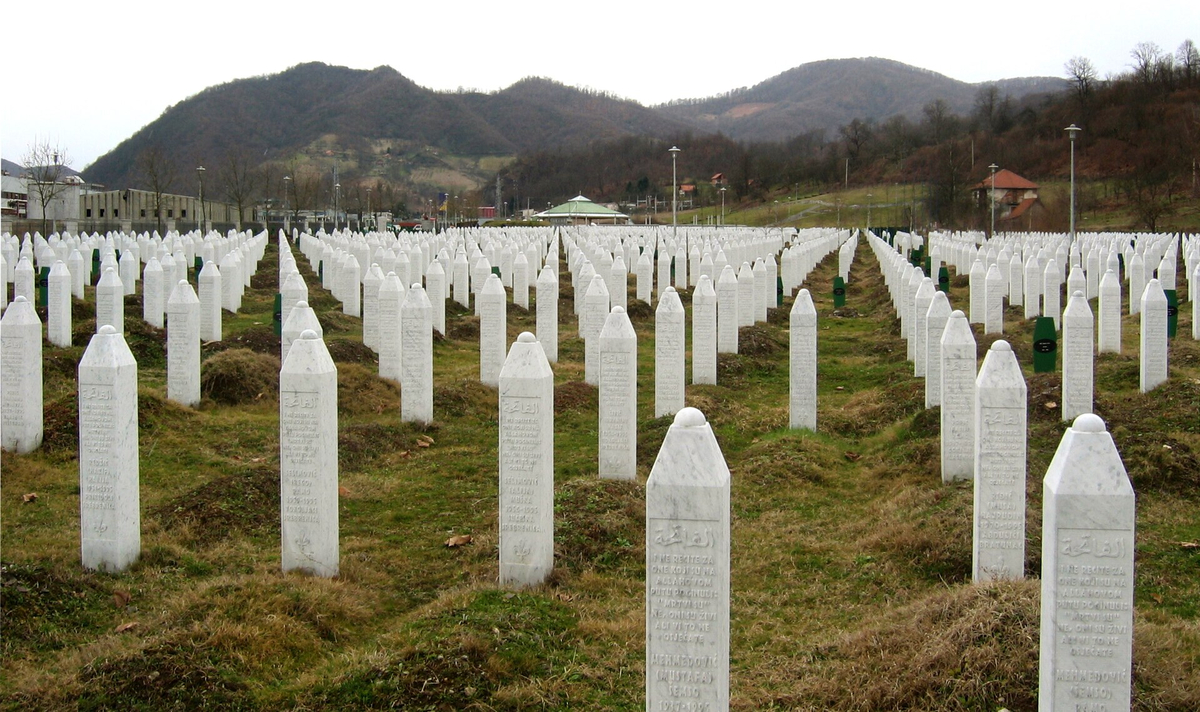
ICJ rules Srebrenica massacre genocide, clears Serbia of direct responsibility.
Bosnia and Herzegovina
Genocide
10 min read
Updated By: History Editorial Network (HEN)
Published:
On February 26, 2007, the International Court of Justice (ICJ) delivered a landmark ruling that formally recognized the 1995 Srebrenica massacre as an act of genocide. This ruling was a significant moment in international law and the history of the Balkans, as it affirmed the gravity of the atrocities committed during the Bosnian War. However, the court also controversially cleared Serbia of direct responsibility for the genocide, a decision that sparked intense debate and had profound implications for the region.
The Srebrenica Massacre: A Genocidal Act
The Srebrenica massacre, which took place in July 1995, remains one of the most horrific events of the Bosnian War. Over the course of several days, more than 8,000 Bosniak men and boys were systematically executed by Bosnian Serb forces after they overran the United Nations-designated "safe area" of Srebrenica in eastern Bosnia and Herzegovina. The massacre was part of a broader campaign of ethnic cleansing aimed at eliminating the Bosniak population from the region.
In the years following the massacre, numerous international bodies, including the International Criminal Tribunal for the Former Yugoslavia (ICTY), recognized the events at Srebrenica as genocide. The ICTY's conviction of Bosnian Serb General Radislav Krstić in 2001 for his role in the massacre was the first time an individual was convicted of genocide by an international court. However, the ICJ's ruling in 2007 marked the first time a sovereign state was held accountable in connection with genocide.
The ICJ Case: Bosnia and Herzegovina vs. Serbia and Montenegro
The case before the ICJ, officially titled Bosnia and Herzegovina v. Serbia and Montenegro, was initiated by Bosnia and Herzegovina in 1993, during the Bosnian War. Bosnia accused Serbia and Montenegro (then known as the Federal Republic of Yugoslavia) of committing genocide against the Bosniak population in Bosnia and Herzegovina. The case focused on Serbia's alleged role in supporting and directing the Bosnian Serb forces responsible for the Srebrenica massacre and other atrocities.
The legal proceedings were complex and protracted, taking more than a decade to reach a conclusion. The case hinged on the question of whether Serbia, as a state, bore direct responsibility for the genocide carried out by the Bosnian Serb forces, and whether it had violated its obligations under the 1948 Genocide Convention.
The ICJ's Ruling: Genocide Affirmed, Serbia Cleared
In its ruling on February 26, 2007, the ICJ made several key determinations:
Recognition of Genocide: The court unequivocally ruled that the massacre at Srebrenica constituted genocide. It cited the intent to destroy, in whole or in part, the Bosniak population in Srebrenica, as well as the systematic nature of the killings, as evidence of genocidal intent.
Serbia's Role: The court concluded that Serbia was not directly responsible for the genocide. While acknowledging that Serbia had provided substantial military and financial support to the Bosnian Serb forces, the ICJ found insufficient evidence to prove that Serbia had specific intent to commit genocide or that it directly participated in the genocide at Srebrenica.
Failure to Prevent and Punish Genocide: Although Serbia was cleared of direct responsibility, the ICJ ruled that Serbia had violated its obligations under the Genocide Convention by failing to prevent the genocide and by failing to cooperate with the ICTY in bringing the perpetrators to justice. The court criticized Serbia for not taking all possible measures to prevent the genocide and for its failure to arrest individuals indicted for genocide, including Ratko Mladić, who was at large at the time of the ruling.
Impact and Reactions
The ICJ's ruling was met with mixed reactions. For the victims and survivors of the Srebrenica massacre, the recognition of genocide was an important affirmation of their suffering and the atrocities committed against their community. However, the court's decision to clear Serbia of direct responsibility was deeply disappointing for many, particularly in Bosnia and Herzegovina, where there had been hopes that Serbia would be held fully accountable for its role in the war.
In Serbia, the ruling was met with a measure of relief, as it avoided a finding of direct state responsibility for genocide. However, the court's criticism of Serbia's failure to prevent the genocide and its failure to cooperate with international justice underscored the need for Serbia to confront its wartime past more fully.
Legacy of the Ruling
The ICJ's ruling in 2007 remains a significant milestone in international law, particularly in the context of state responsibility for genocide. It highlighted the challenges of holding states accountable for such crimes, especially when the direct chain of command and intent are difficult to prove.
The decision also underscored the importance of international mechanisms for addressing atrocities and the ongoing need for reconciliation and justice in the Balkans. The Srebrenica genocide continues to be a painful and divisive issue in the region, and the ICJ's ruling has played a role in shaping the narrative and the pursuit of justice for the victims.
#MomentsOfLife #MoofLife_Moment #MoofLife #ICJ #Srebrenica #Genocide #BosniaAndHerzegovina #InternationalLaw
Primary Reference
Summary of the Judgment of 26 February 2007 | INTERNATIONAL ...
Explore the Life Moments of
 AI Twin