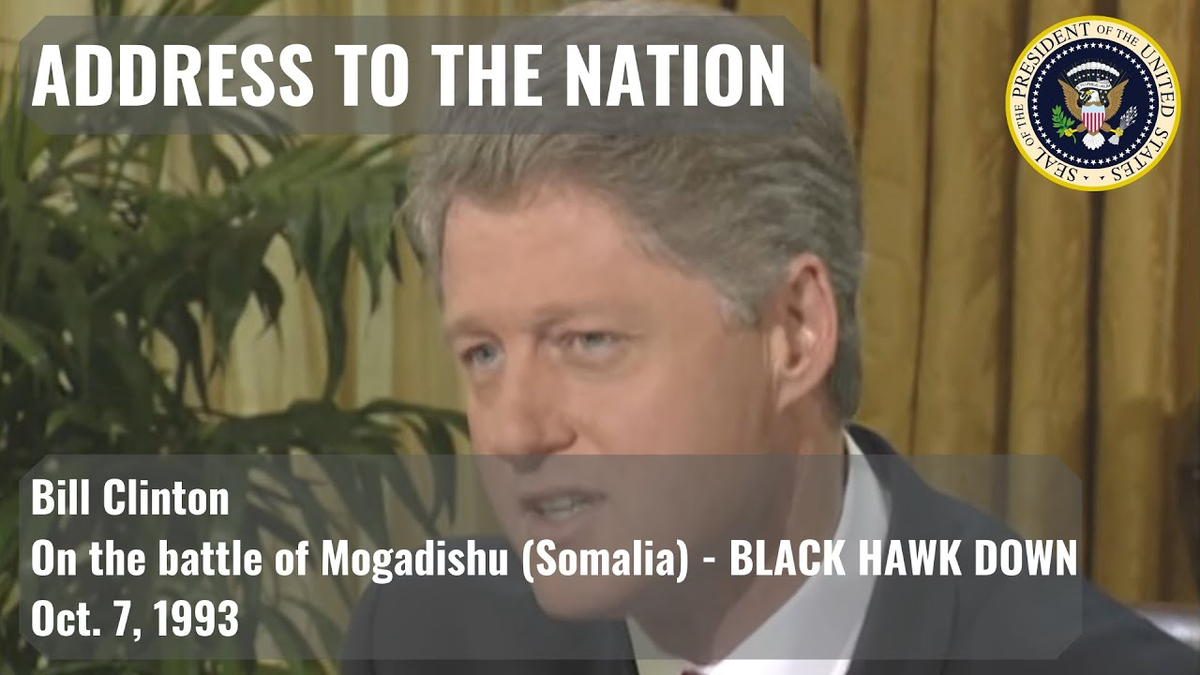
Presidential Speech on US Soldiers in Mogadishu.
United States of America
Political
Global Trade
4 min read
Updated By: History Editorial Network (HEN)
Published:
In the early 1990s, the United States was engaged in a humanitarian mission in Somalia aimed at stabilizing the region and providing relief amidst a devastating civil war and famine. The conflict intensified, leading to a critical operation conducted by U.S. forces to capture warlord Mohamed Farrah Aidid's top lieutenants in the capital city of Mogadishu. This operation saw two Black Hawk helicopters shot down, resulting in a protracted urban battle known as the Battle of Mogadishu.
During this operation, 18 American soldiers lost their lives, and over 70 were wounded. The conflict extended into the streets of Mogadishu for nearly 18 hours, with U.S. forces encountering fierce resistance from Aidid's militia. The incident was marked by intense firefights and significant civilian casualties. The battle's vivid images and reports quickly permeated media globally, resulting in widespread scrutiny and debate over U.S. involvement in Somalia.
The day after the incident, President Bill Clinton addressed the nation, acknowledging the sacrifice of the U.S. soldiers and explaining the mission's goals and outcomes. He assured the nation of America’s commitment to humanitarian efforts but also iterated the need to reassess the extent of U.S. involvement in complex foreign conflicts. This address underscored the strategic and humanitarian challenges faced by the United States in conflict zones.
In the aftermath, the incident profoundly influenced U.S. foreign policy, prompting a reevaluation of military engagements in similar humanitarian and peacekeeping missions. The events in Mogadishu drew attention to the risks associated with such operations and led to increased caution in future deployments.
#Mogadishu #BlackHawkDown #USMilitary #HumanitarianCrisis #ForeignPolicy #BillClinton #UrbanWarfare #MoofLife
Primary Reference
Battle of Mogadishu (1993) - Wikipedia

Explore the Life Moments of
 AI Twin