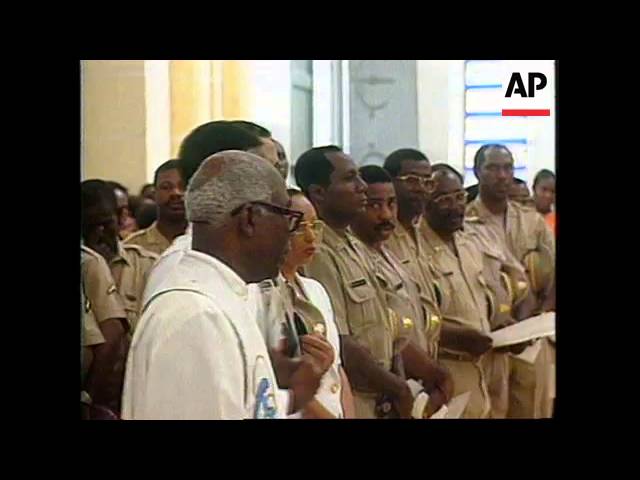
Haitian General Agrees to Cede Power announcement.
United States of America

Political
Global Trade
5 min read
Updated By: History Editorial Network (HEN)
Published:
In an address to the nation, President Bill Clinton announced that Haitian General Raoul Cédras had agreed to cede power. This event marked a critical juncture in U.S.-Haiti relations and a significant point in restoring democratic governance in Haiti. The background to this announcement involves a period marked by instability and human rights abuses following a 1991 coup that ousted the democratically elected President Jean-Bertrand Aristide. The political turmoil had resulted in a humanitarian crisis, compelling thousands of Haitians to flee the country and prompting international intervention.
Negotiations had been underway with the backing of the United Nations and the Organization of American States, aiming to resolve the conflict peacefully. The U.S. played a pivotal role in these negotiations. A military intervention, led by the United States, was on the brink of being executed, an intervention authorized to ensure the restoration of democracy and the safety of the Haitian population. The impending threat of military force by the U.S. and its allies added pressure, leading to the breakthrough agreement with General Cédras.
By agreeing to step down, General Cédras paved the way for the return of exiled President Aristide, which was seen as a restoration of democratic order in Haiti. The announcement helped prevent further conflict and bloodshed, and it led to the deployment of U.S. troops in a peacekeeping capacity rather than a combative role. This development underscored the effectiveness of diplomatic pressure combined with the credible threat of military action in resolving international conflicts.
The impact of this announcement was immediate and far-reaching. It led to the cessation of hostilities and initiated the rebuilding process for the Haitian nation. U.S. involvement in this operation demonstrated its commitment to promoting democracy and stability in the Western Hemisphere. The deployment involved around 20,000 American troops who helped stabilize the situation and provide a platform for future governance and development efforts in Haiti.
This event remains a notable example of how international diplomacy, backed by the threat of force, can achieve significant political change. #MoofLife #Haiti #USForeignPolicy #Democracy #Peacekeeping
Primary Reference
William J. Clinton Event Timeline | The American Presidency Project

Explore the Life Moments of
 AI Twin