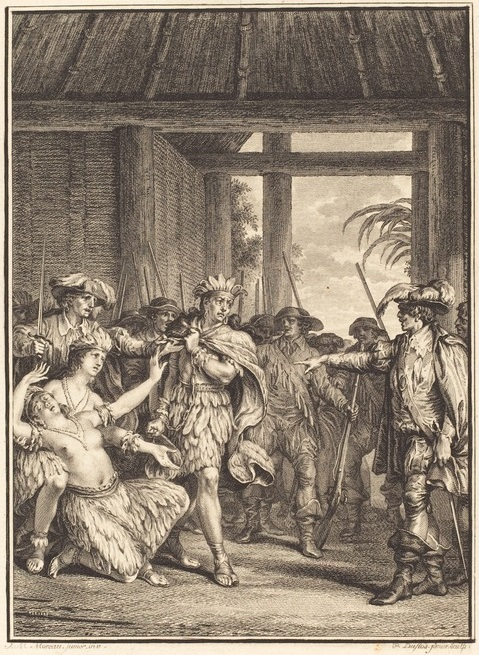
The Indigenous Peoples of the Bahamas During Christopher Columbus' Arrival: A Historical Overview
Bahamas
Culture
Exploration
3 min read
Updated By: History Editorial Network (HEN)
Published:
Updated:
Columbus' first landfall in what was to Europeans a 'New World' was on an island he named San Salvador (known to the Lucayans as Guanahani). While there is a general consensus that this island lay within the Bahamas, precisely which island Columbus landed on is a matter of scholarly debate. Some researchers believe the site to be present-day San Salvador Island (formerly known as Watling's Island), situated in the southeastern Bahamas, whilst an alternative theory holds that Columbus landed to the southeast on Samana Cay, according to calculations made in 1986 by National Geographic writer and editor Joseph Judge, based on Columbus' log. On the landfall island, Columbus made first contact with the Lucayans and exchanged goods with them, claiming the islands for the Crown of Castile, before proceeding to explore the larger isles of the Greater Antilles. The 1494 Treaty of Tordesillas theoretically divided the new territories between the Kingdom of Castile and the Kingdom of Portugal, placing the Bahamas in the Spanish sphere; however they did little to press their claim on the ground. The Spanish did however exploit the native Lucayan peoples, many of whom were enslaved and sent to Hispaniola for use as forced labour. The slaves suffered harsh conditions and most died from contracting diseases to which they had no immunity; half of the Taíno died from smallpox alone. As a result of these depredations the population of the Bahamas was severely diminished.

Explore the Life Moments of
 AI Twin