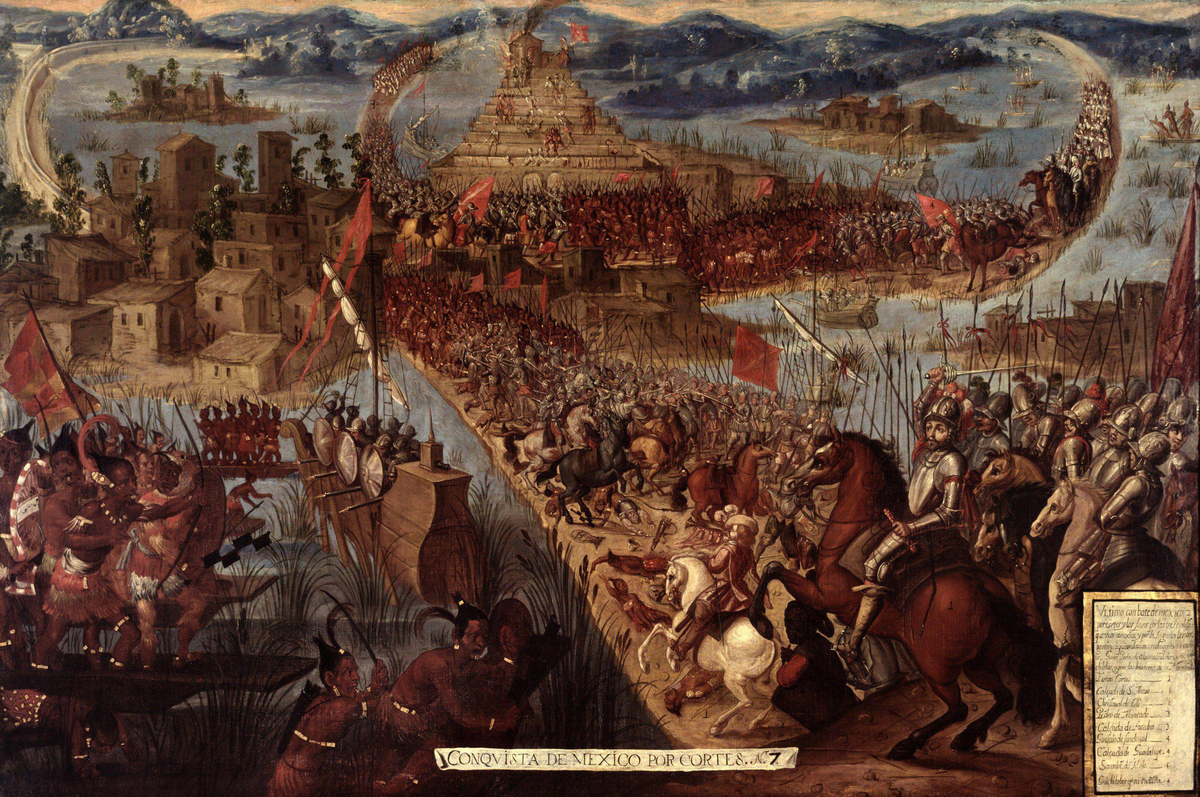
Final Aztec resistance ends; the Spanish capture the city and begin colonization.
enochtitlan, Valley of Mexico, Mexico
FallOfAztecEmpire
8 min read
Updated By: History Editorial Network (HEN)
Published:
Updated:
On 13/08/1521, the city of Tenochtitlan, capital of the Aztec Empire, fell to Spanish forces led by Hernán Cortés and a large coalition of Indigenous allies after a prolonged siege that devastated the city and surrounding region. The fall of Tenochtitlan marked the collapse of Mexica imperial power in central Mexico and laid the foundation for the establishment of New Spain, one of the most important colonial territories of the Spanish Empire. Although some later accounts incorrectly reference 31/08/1521, historians widely recognize 13 August 1521 as the date of the city’s surrender.
Tenochtitlan had been one of the largest and most sophisticated urban centers in the world before the conquest. Founded in 1325 on islands in Lake Texcoco, the city served as the political, religious, and economic center of the Aztec Empire. By the early 16th century, it governed an extensive tributary network across much of Mesoamerica through the Triple Alliance of Tenochtitlan, Texcoco, and Tlacopan. Spanish conquistadors arriving in 1519 described monumental temples, canals, marketplaces, and dense urban populations that rivaled major European cities.
The campaign against the Aztec Empire began after Hernán Cortés landed on the Gulf Coast in 1519 and formed alliances with Indigenous groups hostile to Mexica rule, particularly the Tlaxcalans. Cortés and his allies entered Tenochtitlan in November 1519, where they were initially received by the emperor Moctezuma II. Relations soon deteriorated into violence and political crisis. Following fighting inside the city and the death of Moctezuma, Spanish forces temporarily fled Tenochtitlan during the event known as La Noche Triste in June 1520.
After regrouping, Cortés organized a large-scale siege against the island capital. Spanish brigantines were constructed to control the waters of Lake Texcoco, while allied Indigenous armies attacked the city through its causeways. The siege lasted for approximately three months in 1521 and caused widespread destruction, famine, and disease. Smallpox, introduced to the Americas from Europe, had already spread through central Mexico before the final assault and severely weakened the population.
The last Mexica ruler, Cuauhtémoc, continued resistance as conditions inside the city deteriorated. On 13/08/1521, he was captured while attempting to flee across Lake Texcoco, effectively ending organized defense of Tenochtitlan. Contemporary accounts describe extensive devastation throughout the city following the surrender. Temples, palaces, and residential districts were heavily damaged or destroyed during the siege and subsequent occupation.
Following the conquest, Spanish authorities began constructing Mexico City over the ruins of Tenochtitlan. Churches, colonial government buildings, and European-style urban infrastructure gradually replaced many surviving Mexica structures. The region became the center of New Spain, a colonial territory that extended across much of present-day Mexico, Central America, parts of the Caribbean, and eventually the Philippines.
The conquest also triggered profound demographic, cultural, religious, and political changes across Mesoamerica. Epidemics, forced labor systems, missionary campaigns, and colonial administration transformed Indigenous societies during the 16th century. At the same time, Nahua communities preserved elements of language, historical memory, and cultural traditions that continued long after the fall of the empire.
Historical Significance
The fall of Tenochtitlan in 1521 reshaped the political and cultural history of the Americas by ending the Aztec Empire and establishing Spanish colonial dominance in central Mexico. The conquest connected Mesoamerica more directly to global trade, imperial expansion, and transatlantic exchange, while also initiating centuries of colonial rule that transformed Indigenous societies throughout the region.
#FallOfAztecEmpire
#ColonialBeginnings
#EndOfResistance
#ConquestOfMexico
Primary Reference
Fall of Tenochtitlan

Explore the Life Moments of
 AI Twin