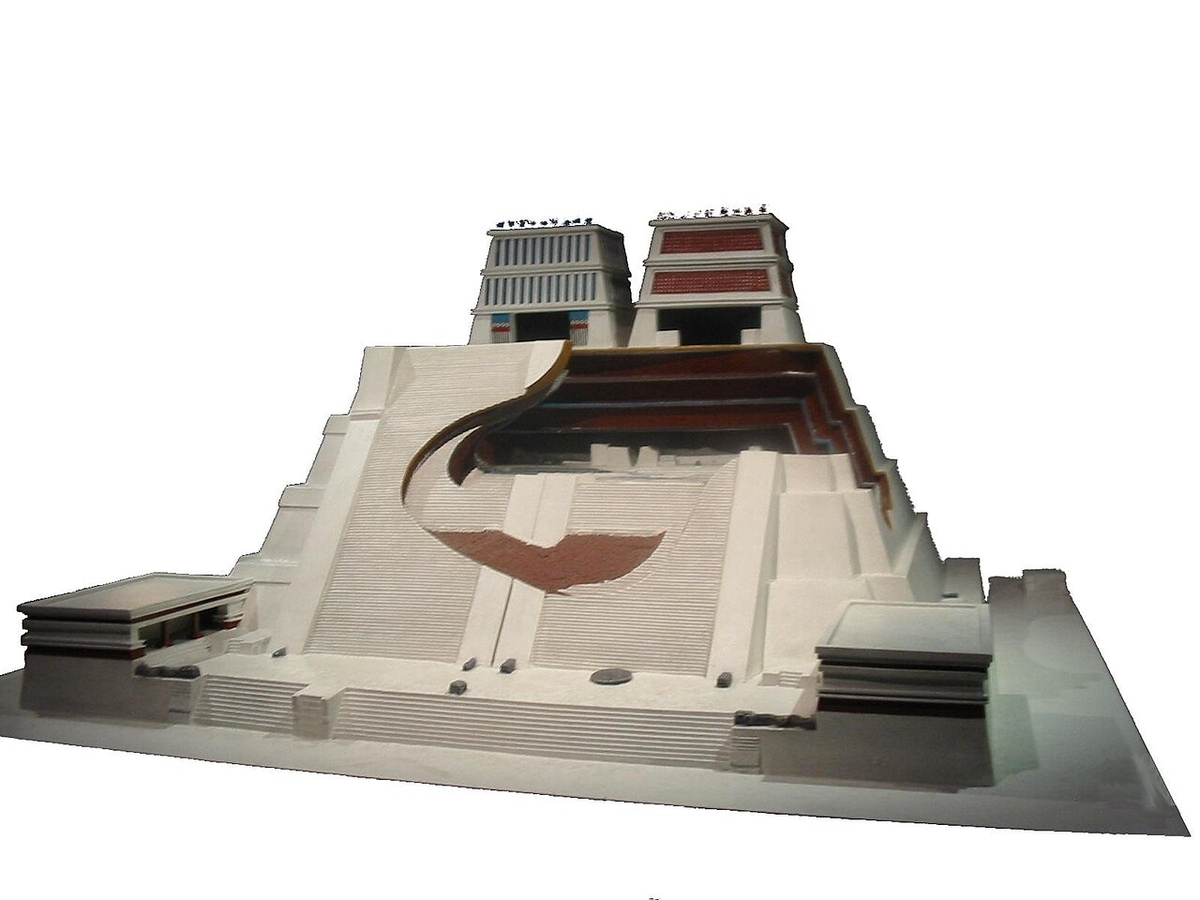
Enlargement of the Great Temple
Tenochtitlan, Valley of Mexico, Mexico
Mesoamerican History
Archaeology
Religious Studies
9 min read
Updated By: History Editorial Network (HEN)
Published:
Updated:
In 1487, the Aztec Empire celebrated the completion and ceremonial rededication of the sixth construction stage of the Templo Mayor, the principal religious pyramid of Tenochtitlan. Conducted during the reign of the Mexica ruler Ahuizotl, the expansion reflected the growing military, political, and religious authority of the Aztec state during the late 15th century. The ceremony became one of the most famous state rituals in Mexica history and symbolized the empire’s position as the dominant power in much of Mesoamerica.
The Templo Mayor stood at the center of Tenochtitlan’s sacred precinct and functioned as the spiritual heart of the Aztec capital. Since the city’s founding in 1325, the pyramid had undergone multiple enlargements as successive rulers expanded the structure to reflect the city’s increasing prestige and population. Rather than demolishing earlier versions, the Mexica typically constructed new layers directly over older temple phases, gradually increasing the monument’s height and scale over time.
The sixth phase of the Templo Mayor was begun under the ruler Tizoc and completed under his successor Ahuizotl, who ruled from 1486 to 1502. This enlargement significantly expanded the pyramid and enhanced its monumental appearance within the ceremonial center of Tenochtitlan. At the summit stood twin shrines dedicated to two of the most important Mexica deities: Huitzilopochtli, the god associated with warfare, the sun, and Mexica identity; and Tlaloc, the rain and agricultural deity connected to fertility and water. The dual-temple arrangement reflected the balance between warfare and agricultural sustenance within Aztec religious ideology.
One of the most important surviving artifacts connected to the 1487 dedication is the Dedication Stone, a carved monument that depicts Tizoc and Ahuizotl performing ritual bloodletting ceremonies. The stone bears the calendrical glyph 7 Reed (7 Acatl), corresponding to the year 1487 in the Mexica calendar system. Ritual bloodletting formed an important part of state religious practice, symbolizing communication with the gods and the renewal of sacred obligations.
The rededication ceremonies reportedly involved large-scale religious rituals attended by nobles, priests, warriors, and visiting dignitaries from across Mesoamerica. Spanish and later colonial chroniclers described massive public ceremonies and sacrificial rites associated with the event, although some numerical claims in these accounts remain debated among historians due to possible exaggeration. Regardless of exact figures, the dedication clearly served as a political display of imperial power intended to reinforce the authority of Ahuizotl and the dominance of Tenochtitlan.
The sacred precinct surrounding the Templo Mayor also underwent major development during this period. The ceremonial complex was enclosed by the Coatepantli, or “Serpent Wall,” decorated with serpent imagery associated with cosmology and sacred protection. Additional structures such as the House of the Eagle Warriors were built or expanded nearby. The House of the Eagle Warriors likely functioned as a ceremonial and military space associated with elite warrior orders that played an important role in Aztec warfare and state ritual.
Under Ahuizotl, the Aztec Empire reached one of its greatest territorial extents. Military campaigns expanded tribute networks across much of central and southern Mexico, bringing wealth and resources into Tenochtitlan. The enlargement of the Templo Mayor reflected this imperial expansion by transforming the ceremonial center into an increasingly monumental representation of Mexica religious and political authority.
The Templo Mayor remained the spiritual center of the empire until the Spanish conquest of Tenochtitlan in 1521. Following the conquest, much of the structure was dismantled or buried beneath colonial Mexico City. Modern archaeological excavations beginning in the 20th century uncovered substantial remains of the temple complex and many associated artifacts, greatly improving historical understanding of Mexica religion and urban life.
Historical Significance
The 1487 rededication of the Templo Mayor demonstrated the close relationship between religion, military expansion, and political authority in the Aztec Empire. The enlarged temple complex became a monumental symbol of Mexica imperial identity during the final decades before European contact.
#mooflife
#MomentOfLife
#TemploMayor
#GreatTemple
#AztecEmpire
#HumanSacrifices
#MesoamericanArchaeology
Primary Reference
Templo Mayor

Explore the Life Moments of
 AI Twin