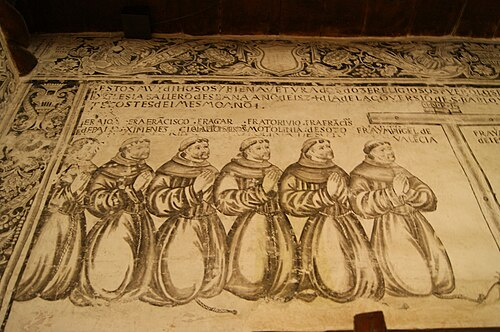
Arrival of the First Franciscans in Mexico
Mexico
Religion
Colonial Studies
9 min read
Updated By: History Editorial Network (HEN)
Published:
Updated:
In May 1524, the first group of Franciscan missionaries officially arrived in New Spain to begin large-scale Christian evangelization in the territories of the former Aztec Empire. Known historically as the “Twelve Apostles of Mexico,” the group was led by Fray Martín de Valencia and had been requested by Hernán Cortés following the Spanish conquest of Tenochtitlan in 1521. Their arrival marked the beginning of a coordinated missionary effort often described by historians as the “spiritual conquest” of central Mexico, a campaign intended to convert Indigenous populations to Christianity and integrate them into the colonial order established by Spain.
The twelve friars belonged to the Franciscan Order, a Catholic religious community known for its emphasis on poverty, missionary work, and education. The group departed from Spain under authorization from both the Spanish Crown and the Catholic Church, arriving in the port city of San Juan de Ulúa before traveling inland toward Mexico City. Fray Martín de Valencia, an experienced religious leader, headed the mission alongside other Franciscans including Toribio de Benavente, later known by the Nahuatl name Motolinía, one of the earliest chroniclers of colonial Mexico.
The Franciscans entered a region still deeply affected by the violence and disruption caused by the conquest of the Aztec Empire. Tenochtitlan had fallen to Spanish and Indigenous allied forces in August 1521 after a prolonged siege that devastated the city and surrounding population. Epidemics, warfare, forced labor, and political restructuring had already transformed much of central Mexico before the missionaries arrived. Within this context, the Franciscan mission sought not only religious conversion but also social reorganization under Christian colonial rule.
The friars established churches, monasteries, schools, and mission centers throughout central Mexico, especially in former Nahua population centers. They learned Indigenous languages such as Nahuatl in order to communicate with local communities and produce religious texts, catechisms, and sermons. Some missionaries also documented Indigenous traditions, beliefs, and social structures, creating valuable historical records that survive today. Among the most important outcomes of this intellectual exchange was the later development of works such as the Florentine Codex compiled under Bernardino de Sahagún.
The conversion process combined persuasion, education, and the destruction or replacement of pre-Hispanic religious institutions. Temples dedicated to Mexica deities were often dismantled or converted into churches, while Christian rituals and festivals were introduced into Indigenous communities. Large-scale baptisms became common during the 1520s and 1530s as missionaries sought rapid conversion of local populations. The Franciscans also trained Indigenous elites and children in Christian doctrine, literacy, music, and European crafts.
At the same time, relationships between missionaries and colonial authorities were sometimes complex. Some Franciscans criticized the harsh treatment of Indigenous populations by Spanish settlers and encomenderos. Figures such as Bartolomé de las Casas and several Franciscan missionaries argued for greater protections for Indigenous peoples, although the broader colonial system continued to impose forced labor, tribute obligations, and cultural transformation.
The “Twelve Apostles of Mexico” became symbolic figures within the history of early colonial New Spain because their mission established the foundation for organized Catholic evangelization across much of Mesoamerica. Their activities helped shape the religious, educational, and cultural institutions that developed in colonial Mexico during the 16th century.
Historical Significance
The arrival of the Franciscan missionaries in 1524 marked the beginning of systematic Christian evangelization in the former Aztec world and played a major role in reshaping religious and social life in New Spain. The mission also contributed to the preservation of important Indigenous languages and historical records, even as colonial authorities sought to transform pre-Hispanic religious traditions.
#mooflife
#MomentOfLife
#Franciscans
#Mexico
#ColonialHistory
#IndigenousCulture
#ReligiousMissions
Primary Reference
Twelve Apostles of Mexico

Explore the Life Moments of
 AI Twin