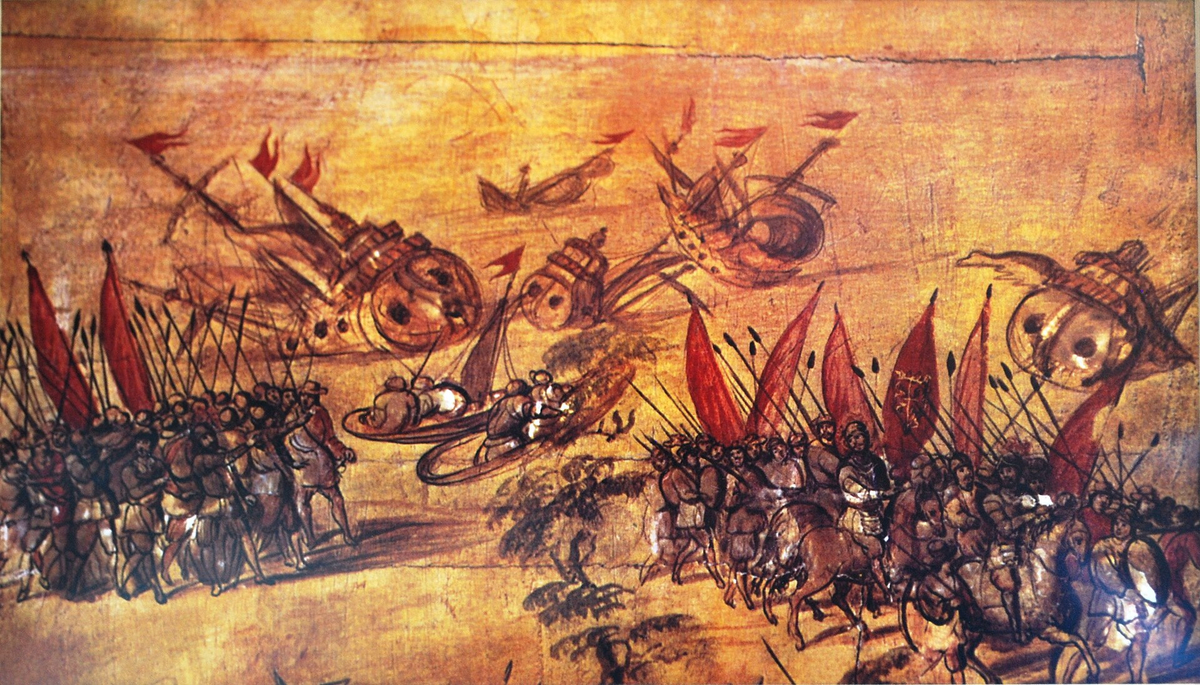
Arrival of Hernán Cortés and Spanish Fleet
Cuba, Gulf Coast of Mexico, and Central Mexico, Mexico
Exploration
Colonialism
9 min read
Updated By: History Editorial Network (HEN)
Published:
Updated:
In February 1519, Spanish conquistador Hernán Cortés departed from Cuba with a small expeditionary force bound for the coast of present-day Mexico, beginning the campaign that would eventually lead to the fall of the Aztec Empire. Cortés commanded a fleet of 11 ships carrying approximately 500 soldiers, along with sailors, interpreters, horses, artillery, and support personnel. His expedition marked the start of one of the most consequential encounters between Europe and the civilizations of the Americas during the early colonial era.
The expedition was launched despite growing tensions between Cortés and Diego Velázquez de Cuéllar, the governor of Cuba. Velázquez had initially authorized Cortés to lead an exploratory and trading mission to the mainland but later attempted to revoke the commission after becoming concerned about Cortés’s ambition and independence. Cortés ignored the cancellation order and sailed anyway, effectively defying the authority of the Cuban governor and acting on his own initiative under the broader authority of the Spanish Crown.
The fleet departed from Cuba in February 1519 and stopped at several locations along the Yucatán Peninsula before reaching the Gulf Coast of Mexico. During the early stages of the expedition, Cortés gained interpreters who became essential to communication with Indigenous societies. Among the most important was Malintzin, also known as La Malinche or Doña Marina, a Nahua woman who spoke both Nahuatl and Maya languages and played a critical role as translator, adviser, and intermediary throughout the campaign.
As Cortés advanced inland, he encountered complex political divisions within Mesoamerica. The Aztec Empire, centered in Tenochtitlan, controlled a large tribute network across central Mexico, but many subject peoples resented Mexica domination and tribute demands. Cortés exploited these tensions by forming alliances with Indigenous groups hostile to the Aztecs, most notably the Tlaxcalans. These alliances proved decisive, as Indigenous allies eventually supplied the majority of the forces used against Tenochtitlan.
In August 1519, Cortés established the settlement of Veracruz on the Gulf Coast, creating a municipal government loyal directly to the Spanish Crown rather than to the governor of Cuba. According to several historical accounts, he also ordered or encouraged the scuttling of some ships to discourage desertion and commit his forces to the inland campaign.
The expedition reached Tenochtitlan in November 1519, where the Mexica ruler Moctezuma II initially received the Spaniards and their allies. Relations between the two sides soon deteriorated amid political tensions, violence, and Spanish attempts to control the city. After months of instability, warfare erupted, leading to the temporary Spanish retreat during La Noche Triste in June 1520.
Cortés reorganized his forces and launched a large-scale siege against Tenochtitlan in 1521 with thousands of Indigenous allies and brigantines constructed to control Lake Texcoco. The city fell on 13 August 1521 after prolonged fighting, famine, and disease devastated the population. The capture of the final Mexica ruler, Cuauhtémoc, marked the collapse of the Aztec Empire and the beginning of Spanish colonial rule in central Mexico.
The campaign initiated major political, cultural, and demographic changes across Mesoamerica. The conquest opened the region to Spanish colonization, Christian missionary activity, transatlantic trade networks, and European imperial expansion. It also coincided with catastrophic epidemics that caused widespread population decline among Indigenous peoples during the 16th century.
Historical Significance
Cortés’s departure from Cuba in 1519 began the military and political campaign that ended the Aztec Empire and transformed the history of the Americas. The expedition connected Mesoamerica directly to the expanding Spanish Empire and initiated centuries of colonial rule that reshaped the cultural and political landscape of Mexico.
#mooflife
#MomentOfLife
#HernánCortés
#SpanishConquistadors
#AztecEmpire
#Tenochtitlan
#SpanishColonization
Primary Reference
Spanish conquest of the Aztec Empire

Explore the Life Moments of
 AI Twin