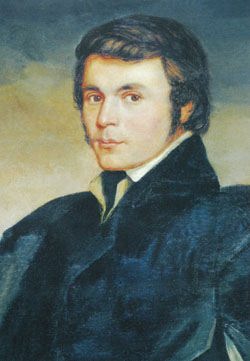
Khachatur Abovian, renowned novelist, poet, and playwright, is born.
Armenia
Literature
8 min read
Updated By: History Editorial Network (HEN)
Published:
On October 15, 1809, Khachatur Abovian was born in Kanaker, a suburb of Yerevan in present-day Armenia. Abovian would grow to become a pivotal figure in Armenian literature and a key proponent of modern Armenian identity, renowned for his contributions as a novelist, poet, and playwright. His legacy is indelibly tied to his pioneering spirit and his commitment to uplifting Armenian culture during a period of significant social and political transformation.
Abovian's early life was marked by an exceptional intellect and a deep curiosity about the world. He received his initial education in Yerevan and later continued his studies at the prestigious Nersisian School in Tbilisi, Georgia. Recognizing his potential, his mentors encouraged him to pursue further education in Europe. Abovian attended the University of Dorpat (now Tartu University) in Estonia, where he studied under the renowned German philosopher and orientalist Friedrich Parrot.
His time in Europe was transformative. It broadened his perspective and exposed him to the Enlightenment ideas that would heavily influence his later works. Abovian became fluent in multiple languages, including Russian and German, which enabled him to translate significant Western works into Armenian and vice versa.
In 1829, Abovian joined Parrot on an ambitious and historic expedition to Mount Ararat, the first recorded ascent of the mountain. This journey not only bolstered Abovian's status as an intellectual and adventurer but also deeply inspired his sense of Armenian national identity. His experiences during this expedition are vividly chronicled in his writings, capturing both the majestic landscape and the enduring spirit of the Armenian people.
Abovian's most famous work, Wounds of Armenia (Վերք Հայաստանի, "Verk Hayastani"), published posthumously in 1858, is considered the first Armenian novel. Written in the vernacular Armenian rather than classical Armenian, the novel was groundbreaking. It vividly depicted the struggles of the Armenian people under Persian and Ottoman domination and called for national awakening and reform. Abovian’s decision to write in the modern vernacular was revolutionary, making literature accessible to the common people and laying the groundwork for the modernization of Armenian literary language.
Beyond his literary contributions, Abovian was a passionate educator and reformer. He believed in the power of education to transform society and worked tirelessly to establish modern schools that provided secular and practical education. His innovative teaching methods and curricula were designed to cultivate critical thinking and civic responsibility among his students.
However, Abovian's progressive ideas often put him at odds with the conservative elements of Armenian society and the Russian imperial authorities. Despite his significant contributions, his later years were fraught with difficulty. In 1848, he mysteriously disappeared, and his fate remains unknown to this day. His sudden disappearance left a profound impact on Armenian society, and he was widely mourned as a national hero and a martyr for Armenian cultural and educational advancement.
Khachatur Abovian’s legacy endures in Armenia and beyond. He is celebrated as a foundational figure in Armenian literature and national consciousness. His works continue to be studied and revered, reflecting the enduring power of his vision for a vibrant and enlightened Armenian society. His life and achievements are a testament to the enduring spirit of cultural resilience and the transformative power of education and literature.
#MomentsOfLife #MoofLife_Moment #MoofLife #KhachaturAbovian #ArmenianLiterature #NationalAwakening
Primary Reference
Khachatur Abovian - Wikipedia

Explore the Life Moments of
 AI Twin