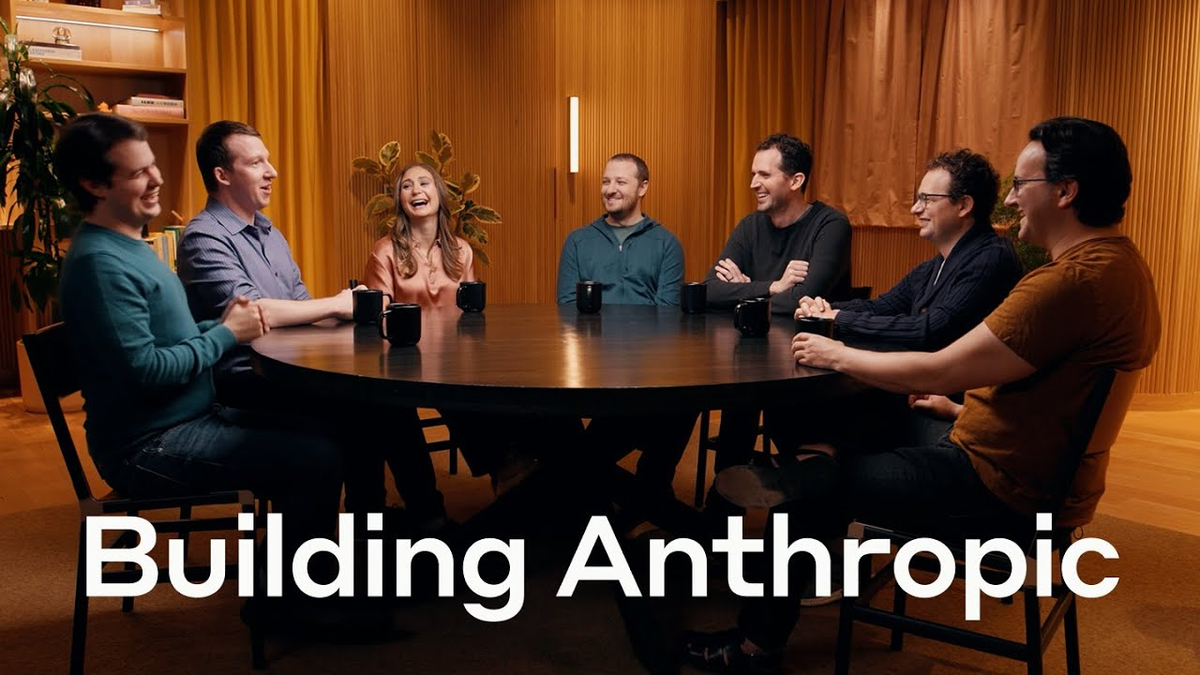
Anthropic founded by former OpenAI members
United States
AI Safety
Technology
Startups
10 min read
Updated By: History Editorial Network (HEN)
Published:
Updated:
Anthropic was founded on 26/01/2021 in the United States by a group of artificial intelligence researchers and leaders who had worked at OpenAI, establishing a new AI company centered on building reliable, interpretable, and steerable systems. Siblings Dario Amodei and Daniela Amodei became Anthropic's CEO and President respectively. Dario had served as OpenAI's Vice President of Research, while Daniela had held a senior safety and policy role. The founding group also included researchers associated with work on large language models, scaling laws, AI safety, and neural-network interpretability. Contemporary and later accounts consistently identify Dario Amodei, Daniela Amodei, Tom Brown, Jack Clark, Jared Kaplan, Sam McCandlish, and Chris Olah among Anthropic's core co-founders, although some sources use a broader definition of the original founding team.
The creation of Anthropic followed the departure of the Amodeis and several colleagues from OpenAI during 2020 and early 2021. Reporting on the split has described disagreements over how increasingly capable AI systems should be developed, commercialized, and governed, with the departing researchers placing particular emphasis on safety research and understanding the behavior of large neural networks. Anthropic subsequently described itself as an "AI safety and research company" and said its work would concentrate on developing AI systems that were reliable and steerable rather than treating capability improvements as the only research objective.
Anthropic was organized as a Public Benefit Corporation. This corporate structure allows a company to pursue commercial objectives while requiring its leadership to consider an identified public benefit alongside shareholders' financial interests. Anthropic has described its purpose as the responsible development and maintenance of advanced AI for the long-term benefit of humanity. The structure became part of a wider governance approach intended to connect the company's research and commercial activities with its stated public-benefit mission.
The company's initial research drew heavily on expertise its team had developed before Anthropic existed. In announcing a $124 million Series A financing on 28/05/2021, Anthropic said members of its team had previously contributed to research involving GPT-3, circuit-based interpretability, multimodal neurons, neural scaling laws, AI and compute, AI safety, and learning from human preferences. The company said the financing would support computationally intensive research into large-scale systems designed to be steerable, interpretable, and robust. Dario Amodei said Anthropic's objective was to make research advances that would enable more capable and reliable AI systems and then deploy them in ways that benefit people.
Interpretability became one of Anthropic's continuing technical research areas. Rather than evaluating an AI model solely through its inputs and outputs, interpretability research attempts to understand internal mechanisms that produce a model's behavior. By April 2022, Anthropic reported that it had been working on mathematically reverse-engineering the behavior of smaller language models and investigating sources of pattern-matching behavior in larger models. The company also researched methods for making language models more helpful and harmless while studying how new capabilities and safety problems could emerge as models increased in scale.
Another identifiable result of this research direction was Constitutional AI. Anthropic publicly presented the approach in December 2022 as a method for training an AI assistant using a written set of principles rather than relying exclusively on humans to label harmful outputs. In the method described by Anthropic, a model generates responses, critiques and revises them according to specified principles, and subsequently uses AI-generated preference information during reinforcement learning. The research was intended to investigate whether AI systems could be trained to follow behavioral principles with substantially less direct human labeling.
Anthropic's founding therefore established a research organization built by former OpenAI personnel around a specific combination of large-scale AI development, safety, interpretability, and model steerability. Those priorities were visible in the company's earliest public research and fundraising announcements and later developed into technical programs including Constitutional AI and mechanistic interpretability.
Why This Moment Matters: Anthropic's creation placed another independent research organization in the emerging field of large-scale general-purpose AI. Its founders carried experience from GPT-3, scaling-law research, interpretability, and AI safety into a separate company whose corporate structure and research agenda explicitly incorporated the problem of controlling and understanding increasingly capable AI systems.
#MomentOfLife
#Anthropic
#AiSafety
#Openai
#LargeLanguageModels
#EthicalAi

Explore the Life Moments of
 AI Twin