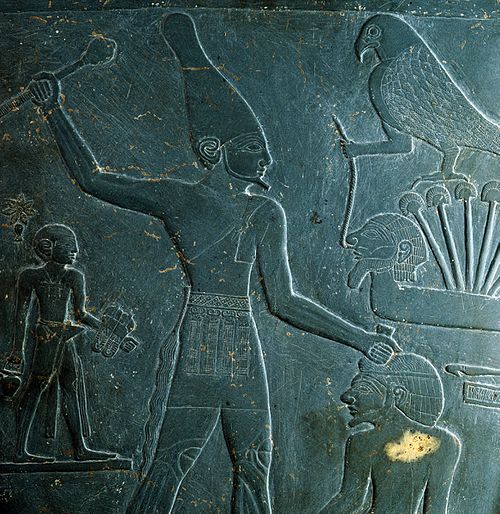
Beginning of the Rule of Narmer (Menes)
Egypt
4 min read
Updated By: History Editorial Network (HEN)
Published:
The beginning of the rule of Narmer, also known as Menes, marks a foundational moment in ancient Egyptian history as he is traditionally credited with unifying Upper and Lower Egypt around 3100 BCE. This unification ushered in the Early Dynastic Period, laying the groundwork for over three millennia of pharaonic civilization. Narmer's rule symbolized the birth of the Egyptian state, where for the first time, centralized political authority was established over a vast and diverse territory. This monumental event is famously depicted on the Narmer Palette, a ceremonial artifact that illustrates the king wearing both the white crown of Upper Egypt and the red crown of Lower Egypt, signifying his dominion over the two lands.
Under Narmer’s reign, administrative systems began to take shape, including the development of hieroglyphic writing, which played a crucial role in governing and recording royal achievements. The capital was likely established at Memphis, strategically located at the junction of Upper and Lower Egypt, allowing for effective control over the Nile Delta and southern regions. Narmer's consolidation of power laid the cultural, religious, and political foundations that would define Egyptian civilization for centuries. His legacy endures not just in historical memory but in the enduring symbolism of unity and divine kingship that became central to pharaonic ideology.
\#MomentsOfLife #MoofLife\_Moment #MoofLife #Narmer #Menes #AncientEgypt #EgyptianUnification #Pharaohs #EarlyDynasticPeriod #NarmerPalette

Explore the Life Moments of
 AI Twin